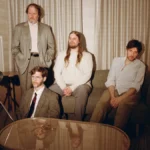

For their third album, Slow Pulp let someone else into the control room. Elliott Kozel, a fellow Wisconsinite, produced Melodie alongside Henry Stoehr and Emily Massey, the first time the band have worked with an outside producer, and the change runs through the record.
Melodie came out on 18 September through ANTI-. It runs to 11 songs, and in an interview with NME, Stoehr and Massey describe it as a record about saying things plainly. “We’re both in our early thirties and understand the importance of being direct with yourself,” Stoehr said.
Why Melodie Needed Another Pair of Ears
Part of the reason was workload. “Elliott definitely felt like a great fit for what we were doing,” Massey told NME. “And it allowed Henry to not wear nine million different hats and focus on the writing.”
Stoehr describes the relief in plainer terms. “I do a lot of it in isolation and bang my head against the wall,” he said. “I think it was helpful to be with another person. For both of us, there was always someone there to either confirm or shut down an idea. I’d be like, ‘Is this worth pursuing for another half hour?’ And he’d say, ‘Hell no!'” His summary: “It was a lot more fun, and less lonely.”
Kozel’s credits are wide. BrooklynVegan’s report of the album announcement lists work with Rosalía, Björk, SZA and Eartheater, and NME adds Indigo De Souza. His old band, Sleeping In The Aviary, left a mark on Massey, Stoehr and the rest of Slow Pulp, NME notes.
The credits on the band’s Bandcamp page show how the work was shared. Melodie is produced by Kozel, Stoehr and Massey, mixed by Stoehr and mastered by Ruairi O’Flaherty at Sterling Sound in Los Angeles. Every song is written by Stoehr and Massey. The band are Alex Leeds on bass, Massey on vocals and guitar, Teddy Mathews on drums and percussion, and Stoehr on guitar.
Thirty Songs, Written Face to Face
The writing changed too. Slow Pulp formed in 2015 and released three EPs before their 2020 debut album, Moveys, which led to tours with Lucy Dacus and Death Cab for Cutie. Progress was not a straight line after that. Massey went back to Wisconsin from Chicago more than once, first to care for her parents after a car crash during work on Moveys, and later for a Covid-era stay in the woods, where she wrote much of the lyrics for 2023’s Yard.
She found the isolation useful. “It quiets my inner critic,” she told NME. “I can let whatever’s happening happen. I’m not too judgmental of it, or myself.” But the band’s songs had tended to start apart before they came together, and this time the pair wanted to be more hands-on.
They traded fragments every two or three days and ended up with something like 30 songs that had a shot at the record. “In a lot of ways it felt like we were getting to know each other again,” Massey said. “We’re in better communication and friendship than we have been for a while.”
Stoehr put it in similar terms when the album was announced in June. “Emily [Massey] and I were reconnecting with how we wrote together when we first met,” he told BrooklynVegan. That habit of trading ideas goes back to when Massey first fell in with Stoehr and his old friends Leeds and Mathews. “When we started doing that 10 years ago, we didn’t really know each other very well,” Massey said. “It’s how we became friends.”
The Song About a Hardware Store in Madison
The album’s closer, “Slip Away”, is the one NME calls its lodestar. It recounts an incident from Stoehr’s early twenties, when he was already at a low ebb and was blanked by friends outside a hardware store in Madison, the band’s hometown. At the time, the rejection seemed to confirm his worst beliefs about himself.
“That was an ambient anxiety,” Stoehr told NME. “Then I wrote the song. I’m like, ‘That’s actually a really specific thing I feel.’ I hadn’t put it into words.” The words are his, but Massey sings them, which is the arrangement across much of Melodie: one writer’s confession, delivered by the other.
The lead single, “Better Man”, works the same way. “In my mid 20s, I entered a phase in my life that felt really stable,” Stoehr told BrooklynVegan. “I had felt so turbulent emotionally up until that point and I desperately wanted to feel that I deserved to experience that.” He described the song as “letting go of control but taking control of myself in a new way, and accepting myself for who I am”. In NME’s reading, Massey’s hook refuses to get pulled into the gloom.
What the Record Sounds Like
The palette is wider than before. NME hears shoegazey noise on the title track, ornate acoustic pop on “These Days” and balladry on “Not for Nothing”, and singles out the power-pop of “Red Car” and the synthy washes of “Better Man”. The album opens with “Yellow and Green” and closes with “Slip Away”.
The full running order is “Yellow and Green”, “These Days”, “Better Man”, “Melodie”, “Red Car”, “Not for Nothing”, “Entertainer”, “Like Me”, “Spill”, “Up to You” and “Slip Away”.
Massey sees the mix of heavy subject matter and light melody as the point. “At the core of it, there are a lot of sad or hard things,” she said. “But we also really love pop melodies and feeling good listening to music. Both things can exist together.”
What the Critics Said
The reception has been split. Stereogum named Melodie its Album of the Week on 15 September, three days before release.
Far Out was far cooler, giving it two and a half stars out of five and arguing that a new style of production and a focus on heartbreak had cost Slow Pulp the charm of their earlier, scuzzier records. Even there, the reviewer picked out “Better Man” as the standout, called “Red Car” a sticky-sweet indie-pop banger, and heard a promising three-track run in “Better Man”, “Melodie” and “Red Car”.
That split follows the change itself. A band that had kept much of the work in-house made a record with a producer in the room, and some listeners hear a clearer band while others miss the rougher edges. Stoehr’s own view is that plainness was the goal. “It’s interesting listening to our old stuff,” he told NME. “I can almost hear myself dancing around something I don’t want to say out loud.”
Where Slow Pulp Play Melodie Next
The band start a North American tour on 16 October at Delmar Hall in St Louis. The run takes in the Wiltern in Los Angeles on 29 October, the 9:30 Club in Washington on 9 November and Brooklyn Paramount in New York on 13 November, before ending at the Sylvee in Madison on 21 November. Snuggle, Her New Knife, Goon, Ivy and Graham Hunt are among the openers, according to BrooklynVegan.
Europe follows in January, with dates listed on Bandcamp at the Columbia Theater in Berlin on 21 January, Le Botanique in Brussels on 23 January and Le Trabendo in Paris on 27 January. The UK and Ireland run starts at the QMU in Glasgow on 29 January, then goes to the Button Factory in Dublin on 30 January, Gorilla in Manchester on 2 February, Thekla in Bristol on 4 February and Project House in Leeds on 5 February. It ends at London’s O2 Kentish Town Forum on 6 February.
For another guitar band working through a new record, we wrote this month about how Protomartyr gave every song on Hotel Usona its own haunted room. Slow Pulp’s change was simpler: after two albums and three EPs, they let someone else help.
About The Author