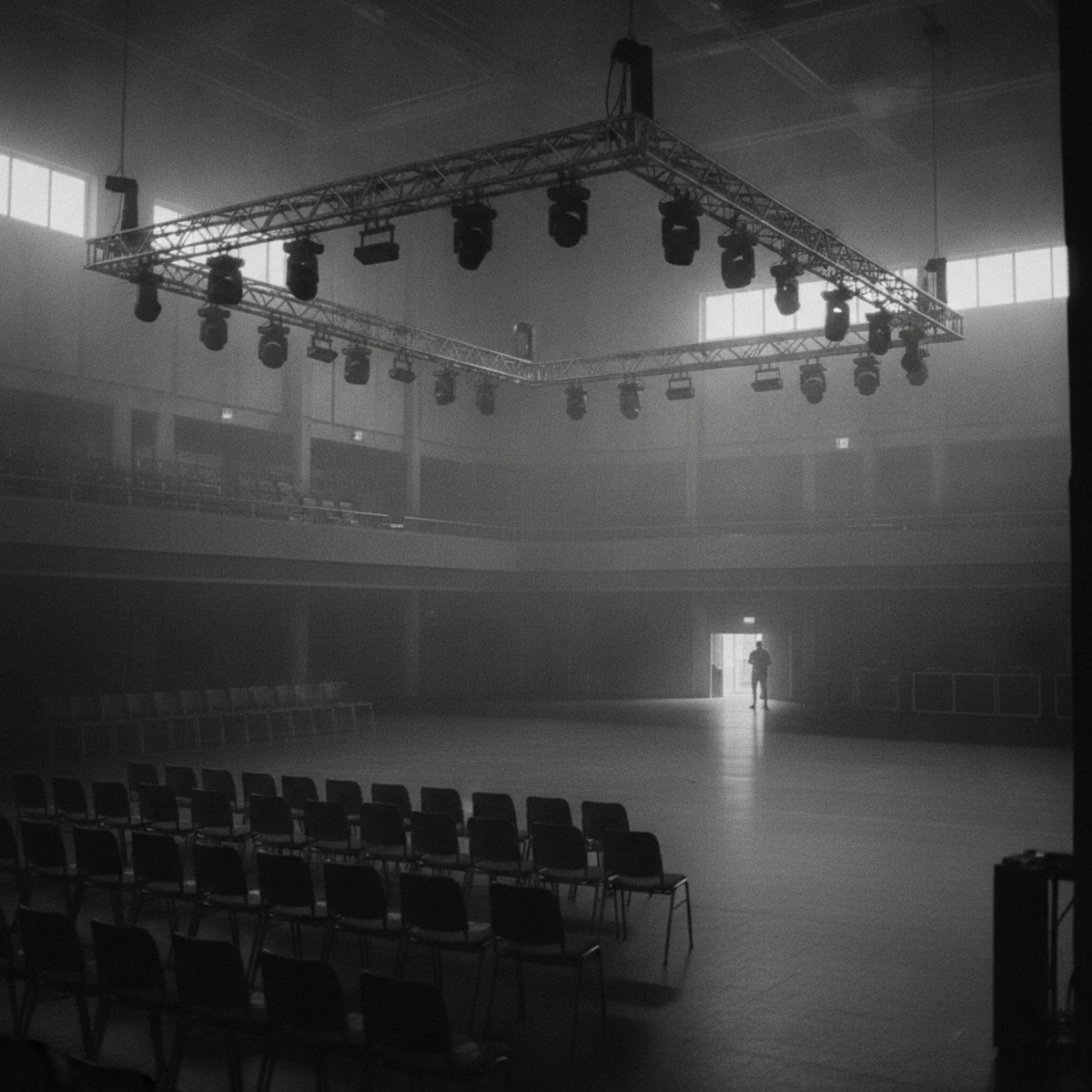
Open in a cheap building, build a scene, get priced out or shut down, repeat elsewhere.
Independent venues follow a life cycle regular enough to predict, and knowing the pattern explains why scenes move around a city rather than settling.
You can listen to our full playlist which contains the artist’s music, and know more about the artist’s work by scrolling down the page.

PLAYLIST
The Cycle Starts With a Cheap Building
Independent venues follow a life cycle regular enough to predict, and it begins with the same condition every time: a usable building in a location nobody currently wants.
That means former industrial premises, redundant commercial space, upper floors above shops, and buildings on the edge of areas considered undesirable. The rent is low because demand is low, and the noise tolerance is high because the neighbours are commercial or absent.
Those two properties, cheapness and noise tolerance, are the entire precondition. They occur together because both follow from the same cause, which is that the surrounding area has no residential value at the time.
A Scene Forms Around the Room
Once a space is running, the effects compound quickly. Bands that had nowhere to play now have somewhere, and the regularity of shows lets an audience form around the venue itself rather than around individual acts.
That audience becomes a resource other people use. Promoters put on nights, a label emerges, bands recruit members from the crowd, and the venue becomes the physical address of a scene that previously had no location.
The building is doing something no online equivalent achieves. It puts the same people in the same room repeatedly, which is the condition under which collaboration actually starts.
Licensing is frequently the specific mechanism rather than rent. A venue operating on a temporary or restricted licence has no security of tenure, and a licence review triggered by a single complaint can end an operation that is otherwise viable.

Success Raises the Rent
The mechanism that ends the cycle is set in motion by the venue’s own success, which is what makes the pattern so consistent and so difficult to escape.
A functioning venue makes an area more attractive. It draws people in the evening, supports nearby food and drink businesses, and gives a district a reputation for being interesting. Those are exactly the qualities that precede residential development.
Property values rise, the area is redeveloped, and the venue faces a rent it cannot pay on margins that were always thin. The venue’s contribution to the area’s desirability is real, and it captures none of the resulting value.
Or the Complaints Arrive First
Where rent does not close it, the new residents often do. Flats are built adjacent to a venue that has operated for a decade, residents arrive, and noise complaints follow within months.
The venue is then required to reduce volume, restrict hours or install soundproofing it cannot afford. Any of the three can be terminal for a business running on small margins.
Agent-of-change legislation, which places responsibility for mitigation on the newer development, addresses this directly and has protected venues where it exists. It is not universal, and it arrived after substantial losses in many cities.
The cycle also produces a documented cultural loss because the venues rarely archive themselves. Flyers, recordings and photographs scatter when a space closes, and scenes are frequently reconstructed later from whatever individuals happened to keep.

The Scene Moves Rather Than Ending
What happens next is the part that makes this a cycle rather than a decline. The people involved do not stop; they find another cheap building somewhere less desirable and start again.
That is why scenes migrate across a city in a traceable path, generally outward from the centre, following the frontier of areas that have not yet been redeveloped. The map of where venues have been is essentially a map of gentrification with a delay.
Each iteration loses something, because the accumulated relationships attached to a specific place do not transfer completely, and each relocation puts the venue further from the people who used it.
What Breaks the Cycle
The interventions that work involve removing the venue from the property market rather than helping it compete within it.
Ownership is the strongest: venues that own their building are not exposed to rent increases and cannot be displaced by a landlord selling. Community ownership models and cultural trusts have achieved this in a number of cases.
Beyond that, planning protection for cultural use, agent-of-change rules and business rate relief all reduce the pressure. None of these is exotic, and where cities have applied them the cycle slows measurably. Where they have not, it runs to completion every time.
Community share ownership has emerged as the most durable answer, since a building owned collectively cannot be sold out from under the people using it. The examples that exist have outlasted comparable rented spaces by a wide margin.





About The Author