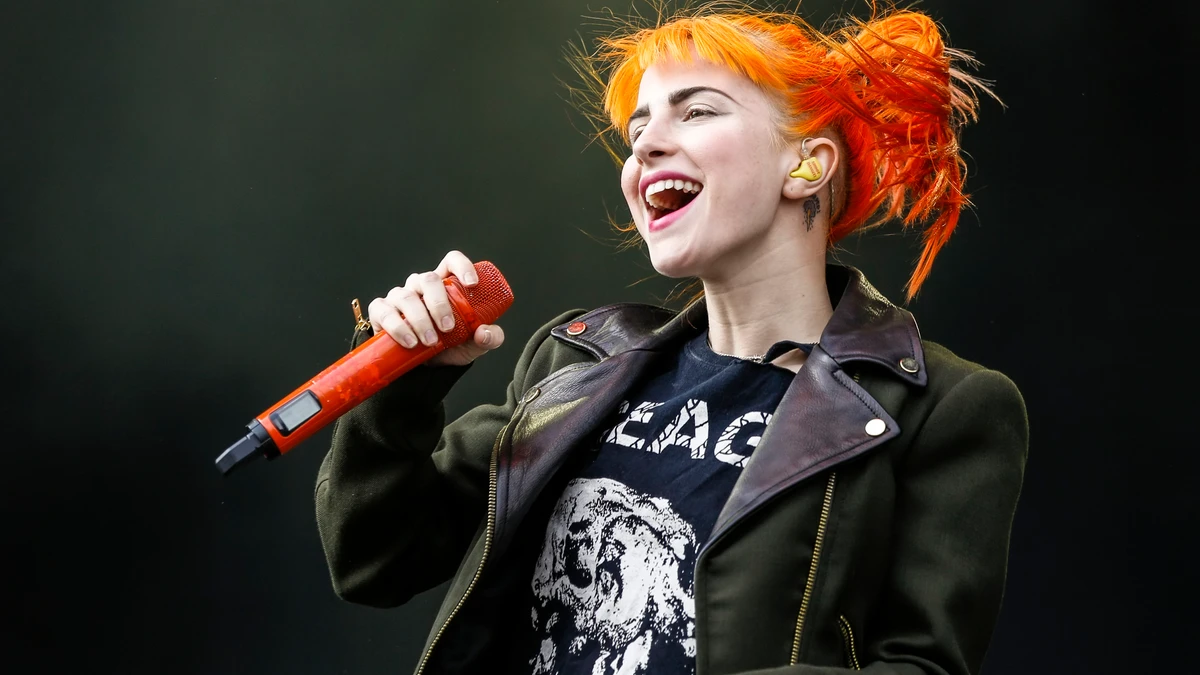
Hayley Williams performing live
Hayley Williams performing live
Opening nights usually hedge. A band plays the singles, keeps the new material to two or three songs and gets through it. Hayley Williams did the opposite on 3 September at the iTHINK Financial Amphitheater in West Palm Beach, putting eight songs in front of an audience for the first time inside a twenty-five-song set.
Two of those eight, Dead Horse and Pure Love, had never been played in front of an audience at all. Crystal Clear was a first as a solo artist. That is a lot of untested material to carry on the first night of a run that goes through October in the United States before heading to South America.
What Was Played for the First Time
The debut list ran to Just a Lover, Over Yet, Creepin’, My Friend, Cinnamon, Dead Horse, Pure Love and Crystal Clear. NME noted that Just a Lover comes from 2021’s FLOWERS for VASES / descansos, which means part of the night was catalogue that had simply never been performed rather than new songs finding a stage.
That distinction matters for how the set holds. A song written five years ago and never toured has a different problem from a song written last year: the band has no muscle memory for it and the audience may not have a strong attachment either. Playing several of both in one night is a deliberate choice to make the first show the hardest one.
The other structural decision was to bookend it. Just a Lover opened the set and returned as a reprise at the end, which frames the whole thing around a song most of the room had never heard live. It is a confident move and it only works if the song lands.
The Tour Was Advertised as Exactly This
The set was not a surprise so much as a promise kept. Williams announced The Hayley Williams Show in May, while her first solo tour was still running, describing it as a separate proposition built on material across all three of her solo albums plus what she called some exciting surprises.
That is a specific commitment, and it explains the structure. Stereogum reported that speculation ahead of the run had focused on how far into the catalogue the set would go, which is a reasonable question to ask of an artist announcing a second, differently-framed tour within months of the first.
The answer, on the evidence of night one, is further than most artists would risk. Announcing a deep-catalogue tour and then delivering eight first-time performances on the opening night is unusually literal follow-through, and it sets an expectation the rest of the run now has to meet.
The Two Covers Were Not Filler
Simmer came back with a snippet of Portishead’s Wandering Star inside it, the first time she has played Simmer as a solo artist since 2020. Pairing the two is a real reading rather than a nod: both are built on restraint and a bassline that refuses to resolve, and the join is closer than it sounds on paper.
The second cover was Nina Simone’s Don’t Let Me Be Misunderstood, placed mid-set between True Believer and Cinnamon. That is a demanding song to attempt in an amphitheatre, because it lives or dies on phrasing rather than volume, and choosing it in that slot suggests the intention was to reset the room’s attention rather than to lift it.
Neither cover is a crowd-pleaser in the conventional sense. Both are chosen for what they say about the material around them, which is what separates a considered set from a run-through.
The Shape of the Night
Twenty-five songs is long for an amphitheatre, and the sequencing worked in blocks. The opening four moved from Just a Lover through Simmer and Creepin’ to Ice in My OJ. The middle stretch, from Kill Me through Roses/Lotus/Violet/Iris and True Believer, carried most of the familiar material. The debuts clustered in the back third, with Cinnamon, Dead Horse, Pure Love and Crystal Clear running consecutively.
Putting four untested songs back to back that late is unusual and slightly risky, since it asks an audience to stay with unfamiliar material at the point in the night when they are most primed for songs they know. It also means the last third of the show is where the tour will change most as the run continues.
The encore went Mirtazapine, Brotherly Hate and Parachute, which is a conventional close after an unconventional set. Consequence published the full running order along with video from the night.
Why This Album Earns a Second Run
The tour supports Ego Death at a Bachelorette Party, released in August 2025 after being previewed as Ego the month before, and this is the second North American run behind it. A second lap on the same album is not automatic at this level, and it usually means either the record kept selling or the live show became the point.
The reception supports the first reading. NME gave the album five stars and described it as a bold choose-your-own-adventure through hope and heartache, which is a fair description of a record that keeps changing register rather than settling into one.
Structurally, a record like that is difficult to tour, because a set has to impose an order on material designed to resist one. Eight debuts on night one suggests the answer arrived at was to expand rather than tighten: play more of it, including the songs that had been sitting unplayed, and let the sequence do the work.
Where the Run Goes From Here
The US leg continues through September and into October at amphitheatres including Forest Hills Stadium in New York for two nights and the Hollywood Bowl in Los Angeles for two more, closing at BankPlus Amphitheater in Southaven on 12 October. It also takes in the All Things Go Festival in Columbia, Maryland on 26 September.
After that the run leaves North America. South American dates follow in November across Brazil, Argentina, Chile, Peru, Colombia, Mexico and Puerto Rico, and UK and European shows are booked into summer 2027, including Glasgow’s OVO Hydro and London’s Alexandra Palace.
That is a long calendar, and it changes what an opening night means. A set built to test eight songs at once is a reasonable investment when there are more than a hundred shows in front of it, and a much stranger one when there are twenty.
What the Setlist Says About the Solo Project
Drawing twenty-five songs from three solo albums, with no material from the band that made her name, is the clearest statement in the whole evening. This is a catalogue deep enough to fill a night on its own now, and the set is built as though that has already been settled rather than as though it needs arguing.
Support from Rico Nasty and Magdalena Bay points the same way. Neither is an obvious rock booking, and both signal an audience being built around this project specifically rather than inherited wholesale. BestRock.News made a related point when Metronomy stopped touring without breaking up: what an act chooses to play, and with whom, is usually a clearer statement than anything announced.
The practical test comes over the next fortnight. Eight debuts in one night is a statement; eight debuts that survive into the twentieth show is a set. Whether the four-song run of new material in the back third holds its place, or gets broken up as the tour learns what works, is the thing worth tracking as the run moves north.
About The Author