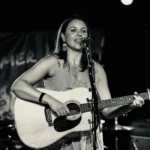
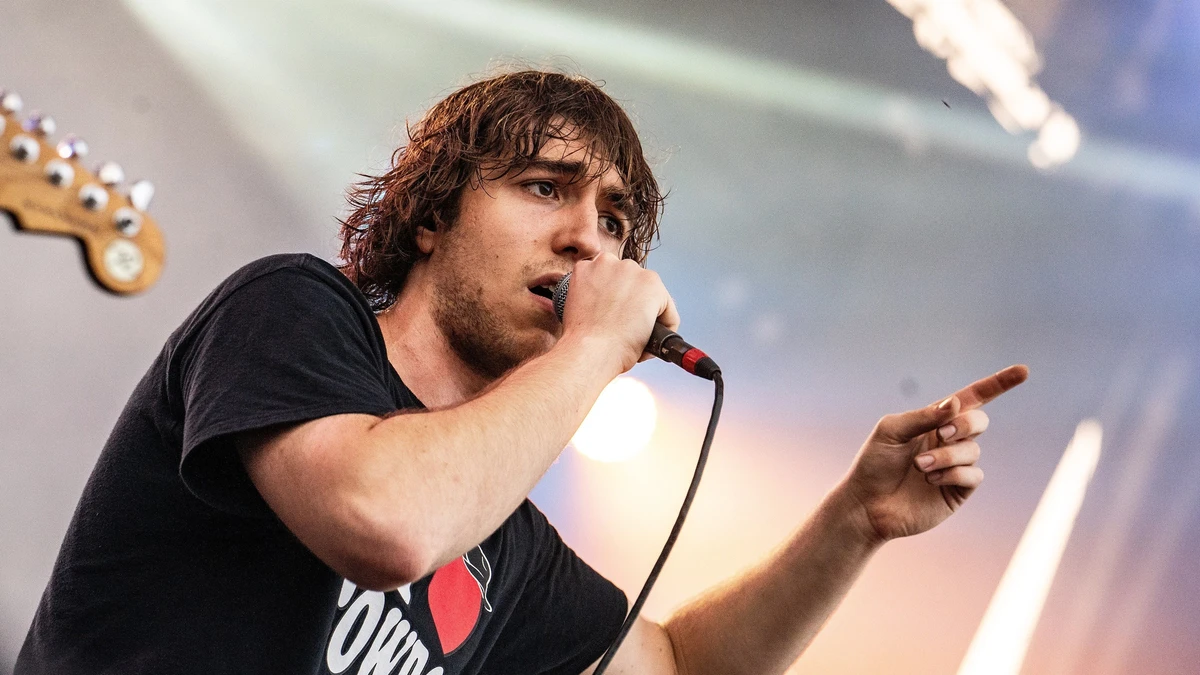
Cameron Winter performing with Geese in Boston in 2024
Cameron Winter performing with Geese in Boston in 2024
Most cinemas cannot show it. “Cameron Winter at Carnegie Hall”, Paul Thomas Anderson’s concert film of the Geese frontman, is being exhibited only on 35mm film, which rules out every screen that went digital and never kept a projector. In three theatres in New York and Los Angeles on its opening weekend, it took $162,000, a per-screen average of $54,000.
That constraint is the whole release strategy. The film is touring North America like a band, playing historic theatres that still run celluloid, before it opens nationwide on 28 January 2027. It is a slow, deliberately awkward way to put out a 75-minute film of one man at a piano, and so far it is working.
Only Cinemas With a Film Projector Can Play It
Janus Films and Criterion, which are releasing the film, set out the numbers to IndieWire. “Cameron Winter at Carnegie Hall” is the largest exclusively-on-film theatrical release in more than 15 years, roughly since the industry’s switch to digital projection. By January it will have played on celluloid in more than 60 markets.
The limitation is real. Not every venue is equipped to show 35mm, which restricts where the film can play in its first run. The distributors say it already has full houses for upcoming screenings in some of the largest historic theatres in the country, including in New York, Los Angeles, San Francisco, Chicago, Boston, Vancouver, Toronto, Atlanta and Minneapolis, and more than a dozen other cities.
IndieWire called the opening gross impressive, and for a film built around a solo piano set it is. The per-screen figure reflects demand concentrated into a handful of rooms, which is exactly what a scarce-format release is designed to produce.
A Release Plan Borrowed From Stop Making Sense
The plan is loosely modelled on Jonathan Demme’s 1984 Talking Heads film, “Stop Making Sense”, which was shown in music venues with a staggered nationwide release, IndieWire reported. Tickets for the wider rollout go on sale this week, ahead of the 28 January opening.
The comparison runs deeper than logistics. Demme is one of Anderson’s heroes, the A.V. Club noted, and “Stop Making Sense” set the standard for conveying the electricity and immediacy of live performance. Anderson, whose earlier films include “Boogie Nights” and “There Will Be Blood”, is borrowing the release model and the restraint together.
For a music audience used to watching concerts on a phone, a release that requires a trip to a specific theatre on a specific night is a throwback. It treats the screening as an event, which is what a gig is, and it limits supply in a way that streaming never does.
One Man, One Piano, One Room
The film captures Winter’s solo show at Carnegie Hall on 11 December 2025. Most of the songs come from his 2024 solo album, “Heavy Metal”, where they were stripped down with acoustic guitars, spare drums, keyboards and a little French horn, according to the A.V. Club. On this tour he went further: just Winter and a Steinway, playing for much of the show with his back to the audience.
The A.V. Club traced the idea back to MTV’s “Unplugged”, which popularised the biggest artists in the world paring back their instrumentation, and noted that the trend quickly became a gimmick. Its argument is that Winter avoids the trap. Rather than simply burying the album versions, the show makes the case Geese fans have been making for a while about his stage presence.
He was 23 when he played it, one of the youngest people ever to headline Carnegie Hall. IndieWire noted that Bob Dylan edged him out, having done it in 1963 at 22. The music was recorded and produced for the film, and for a live album, by Ariel Rechtshaid. That album, “Live at Carnegie Hall”, came out last month.
The setlist leans on the quieter, stranger end of his writing. The A.V. Club singled out “Love Takes Miles”, “Cancer of the Skull” and “$0”, the last of which, it noted, lightly mirrors the melody of “Christmas Time Is Here”. Winter rarely talks to the crowd and moves quickly from song to song.
What Anderson Brought to the Room
Anderson made the film in the middle of the awards campaign for “One Battle After Another”, which went on to win Oscars for its screenplay, its direction and Best Picture. He is no stranger to music work, having shot videos for Haim and Radiohead, made Thom Yorke’s short film “Anima” and directed the 2015 documentary “Junun”.
He shot this one on 35mm too, and chose restraint. A solo pianist offers none of the cutaways a full band gives a director, and the A.V. Club credits Anderson with resisting the urge to cut around for an artificial sense of energy. “As was true with Demme, he understands the power of a sustained take,” the review said, describing a camera that holds on Winter as he gives himself over to the material.
The film was produced by Sara Murphy, Erica Frauman and Maggie Ambrose, with the filmmaker and actor Benny Safdie as a co-producer. One shot stayed with the A.V. Club’s critic above the rest: Winter’s silhouette projected high on the hall’s wall, which the review called “an instant bit of mythmaking”.
What the Critics Heard
Reviews have been strong. IndieWire’s Ryan Lattanzio called it “a deeply achey, sincere but never cloyingly earnest concert movie that’s tender to the point of frailty”, while Variety’s Owen Gleiberman wrote that it casts a “sonorous spell”, both quoted in IndieWire’s report on the release.
The A.V. Club’s review is the most telling, because it comes from a sceptic. Its writer admits to finding Winter’s voice “an unwieldy mixture of eccentric and distracting”, then concedes that the film turns an intimate show into something transcendent. “Winter barely moves, and yet the performance is volcanic,” the review said.
The voice is the sticking point for doubters, and the review is candid about it. With Geese and on his solo records, it said, the singing can come across as needlessly showy. Here the flourishes fall away, and the critic reached for Rufus Wainwright’s soaring tenor, “albeit with extra bite”, and a young Bob Dylan as comparisons.
Its verdict on the gap between the film and the live album is blunt: “With Cameron Winter At Carnegie Hall, you feel like you were.” That is the useful test for a concert film, and the format helps it pass. Seeing it in a full room, on film, at a fixed time, is about as close to the original night as a screen can get.
Meanwhile, Geese Are Still on the Road
None of this has slowed the band. Geese played the first of two nights at Roadrunner in Boston on 10 November, on a tour behind their fourth album, “Getting Killed”, which the Boston Globe noted is frequently cited as one of 2025’s best. The paper described a 90-minute set covering nearly every song from “Getting Killed” and five from 2023’s “3D Country”, with the crowd on the floor forming a mosh pit at several points.
The Globe placed the band in a New York underground lineage running from Television to Parquet Courts. Winter opened on electric keyboard with “Long Island City Here I Come”, and the night ended not with the usual crowd-pleaser but with an extended jam on “Trinidad”. The paper’s closing comparison was to Talking Heads and Pixies, bands that broke the mould before them, which makes the “Stop Making Sense” template for the film look less like a marketing hook and more like a fit.
The Globe also recalled how close the Brooklyn band came to splitting. Five years ago they were fresh out of high school and releasing a major-label debut, and they thought about breaking up, with members considering Boston University and Oberlin College. In the past year they have appeared on “Saturday Night Live” and played Coachella, and their frontman has played Carnegie Hall.
The two projects pull in opposite directions: a loud, restless art-rock band in packed rooms, and a solo pianist filmed in a concert hall on stock most cinemas cannot run. Limits shape releases as much as records, as a label-free budget does at the other end of the scale. For Winter, the narrow route to the screen has become the selling point, and the January rollout will show how far it can travel.
About The Author