
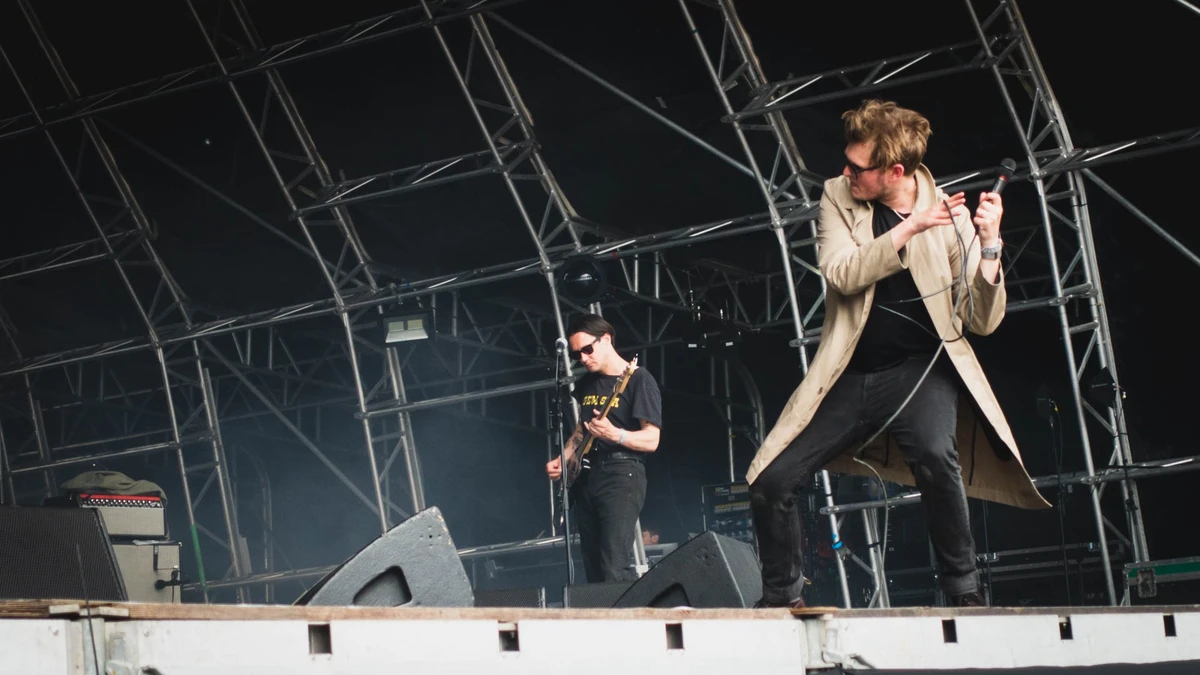
Yard Act’s first two albums were, in singer James Smith’s phrase, laptop records. The third was written by four people in a room they built themselves.
You’re Gonna Need a Little Music arrived on 17 July through Island, running forty-one minutes and forty-three seconds and produced by Justin Meldal-Johnsen with the band.
The First One Made as a Band
The circumstances of the first two records explain the shift. The Overload was written before Yard Act had become a touring unit, and the writing for Where’s My Utopia? happened during the tour for that debut.
Neither of those situations allows a band to write together. The first predates the band existing as one; the second means writing in hotel rooms and dressing rooms, alone, with files exchanged rather than parts played.
For this record they assembled a dedicated studio space in Leeds and wrote forty or fifty songs in it. Smith described the process as feeling “like freedom”, and as encapsulating everything he had originally wanted out of being in a band. Our piece on the rehearsal room problem covers why space of your own is harder to come by than it sounds.
Forty or fifty songs for a twelve-song album is the same ratio other bands describe after long writing periods, and it is only available to a group who can play together whenever they choose.
The difference should be audible. A laptop record is built by one person deciding what each part does; a band record is built by four people finding out what the parts do when played at once.
The Producer’s Monkees Analogy
Meldal-Johnsen’s contribution appears to have been conceptual as much as technical. Smith quoted him at length on what the sessions were for.
“This is the first time it’s been a full team effort,” Smith said. “Justin said, ‘I think you guys are like the Monkees: all four of you could have your own TV show, but the band is greater than the sum of its parts. So I want everyone’s individuality to shine on this record. I want everyone to be able to see what makes a Yard Act record, because you can sense the people within it,’ which I think as a sort of recording philosophy is amazing. And I think he managed that.”
The Monkees is a provocative comparison to hand a post-punk band, given the group’s reputation as an assembled television creation. Used this way it means something narrower and more useful: four distinct personalities, each legible on their own, which is a description of casting rather than an insult about authenticity.
As a production brief it is unusually specific. “Let everyone’s individuality show” tells an engineer what to do with a mix — keep parts separate and identifiable rather than blending them into a single texture.
Meldal-Johnsen’s track record explains why the band listened. He has worked with Nine Inch Nails, M83, Beck and St. Vincent, which is a spread covering industrial rock, maximal synth-pop and two of the more meticulous American songwriters of the century.
Leeds and Los Angeles
The recording split across three rooms: Chapel and The Nave in Leeds, and Chez JMJ in Los Angeles.
That is a deliberate combination rather than a compromise. The Leeds sessions are where a band writes together in its own city; the Los Angeles sessions are where a producer works in his own space with his own equipment.
Splitting a record between the two lets each place do what it is good for, which is only possible if the writing is genuinely finished before anyone flies anywhere.
It is also a meaningful expense. Flying a four-piece to California to finish a record is a decision a label signs off on, and it indicates Island backing the band’s judgment rather than economising on a third album.
Two singles preceded it: “Redeemer” on 7 May and “New Beginnings” on 23 June, three weeks before release. Two singles across ten weeks is a restrained campaign for a band on a major label.
Restraint is the correct instinct for a record whose selling point is that it was played rather than assembled. Four or five singles would fragment it back into the individual tracks the method was designed to move past.
The forty-one-minute runtime works the same way. Long enough to be a proper album, short enough that nothing needed to be included to fill it, and from a pool of forty or fifty songs there was no shortage to pad around.
An Album About Not Sharing a Reality
Lyrically Smith moved away from the approach that made the band’s name. Where the Dark Days EP and the debut worked in vignettes — small, sharply drawn character sketches — this record is more abstract.
The stated subject is the danger of multiple competing realities and of hyper-individualism: how an internet-driven world encourages people into echo chambers, until a shared, objective reality becomes something society has to question the existence of.
That is a hard subject for a band whose strength was specificity. A vignette about a particular person in a particular street is easy to picture; an argument about epistemology is not, and the abstraction is a genuine risk.
It also sits oddly and interestingly against the making of the record. An album about people isolating into private realities, written by four people in one room after two records made separately, has its answer built into its method.
A Metacritic 77 With One Clear Dissent
The reception was good. The album holds a Metacritic score of 77 and 7.8 out of 10 at Any Decent Music, with positive notices from AllMusic, DIY, Dork and Mojo.
Clash was the outlier, giving five out of ten — a full standard deviation below everybody else, and the kind of split that usually means a reviewer disliked precisely what the others valued. On a record that deliberately traded sharp vignettes for abstraction, that is not hard to imagine.
Commercially it did what a third album by a band at this level does: number fifteen on the UK Albums Chart, number three in Scotland, and number three on the UK physical albums chart.
That last figure is the most informative. A record charting far higher on physical sales than overall means an audience that buys objects rather than streams — a committed following rather than a passing one, which is the base a band needs before it can afford to get abstract.
Number three in Scotland against fifteen across the UK points the same way. Regional strength is what a touring band accumulates city by city, and it shows up in the charts of countries with smaller markets before it shows up nationally.
Three albums in five years is also a working rate rather than a careful one. Yard Act have released consistently since the debut and toured continuously between records, which is how a band ends up needing to build its own studio in the first place.
Whether the abstraction was the right move will settle over the next record. What this one establishes is that the four of them can make an album in a room together, which after two attempts assembled elsewhere was not a given.
You’re Gonna Need a Little Music is out now on Island.
About The Author