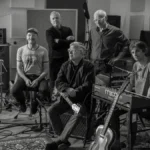
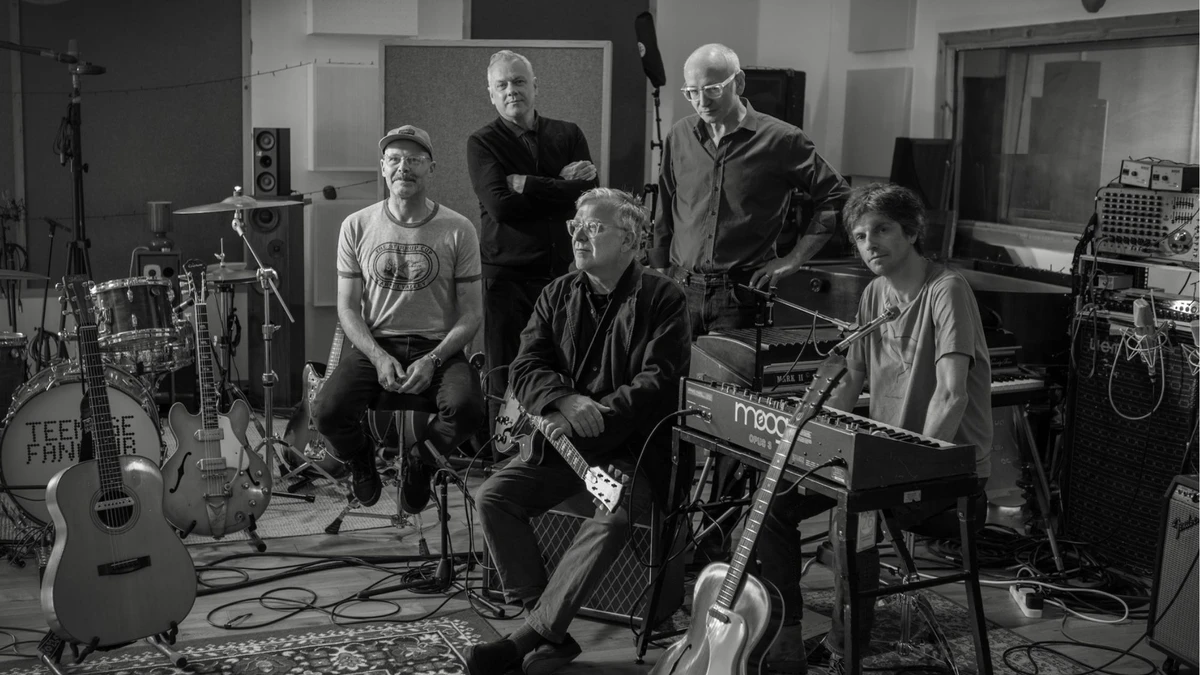
The room was on Great Bernera, a small island in the Outer Hebrides. Teenage Fanclub took the five-piece there to play the songs for their thirteenth album live, as a band, at Black Bay Studio in Kirkibost. The vocals and the smaller additions were done later, at home in Glasgow. The result, Do Not Dare To Dream, came out on Merge on 9 October: ten songs, 39 minutes, produced by the band themselves.
That split, full-band takes in a remote room and the finishing work in the city, is the clearest way to read the record. It is not a loud album and it was never going to be. Teenage Fanclub’s recent records have moved steadily away from the feedback of their early years, and this one goes further along that road.
Recorded Live on Great Bernera
The album credits are specific about who did what. The full band performances were recorded at Black Bay Studio, Kirkibost, with sessions engineered by Cal Roden, David Henderson and Pete Fletcher. Vocals and other parts were added at home in Glasgow. Dexter George mixed and mastered the record in Glasgow, Chris Muth cut the vinyl lacquers, and the sleeve art is by H. Hawkline. The band are credited as producers.
The current line-up is a quintet: Norman Blake and Raymond McGinley, who have been at the centre of the band for close to four decades, with Euros Childs, Francis Macdonald and David McGowan. The writing is split exactly in half. Blake wrote five songs, among them the opener “There Was You”, the title track “I Do Not Dare to Dream” and the single “Day in the Sun”. McGinley wrote the other five, including “Tomorrow People”, “Over and Over” and the closer “Young and Wise”.
The studio itself left a mark on the arrangements. Reviewing the album for Mojo, Victoria Segal picked out Childs’ keyboards and the studio’s church organ as prominent features. The Fire Note heard “warm guitars, soft organ tones, and harmonies polished until every voice seems to settle perfectly.” The lead single’s video, directed by Donald Milne, was also filmed at Black Bay, so the island is the visual identity of the campaign as well as the place the songs were tracked.
A Title Built to Argue With Itself
The album’s name sounds like a motivational poster, and that is the point. Blake has said the title is aimed at exactly that kind of message. “Those ‘dare to dream’ sentiments are kind of ridiculous, I don’t think the world works that way,” he said when the album was announced in July.
The Bandcamp notes describe the record as “calmly resolute, taking stock of the fraught state of the world without succumbing to despair,” and the reviews bear that out. The Fire Note heard songs that “balance themes of aging and self-reflection with a quiet optimism that feels earned”, and every review describes the same steady, unhurried mood holding across the 39 minutes.
That is where the island matters. A record cut live in an isolated room tends to sound like the people in the room listening to each other, and this one does. John Murphy, reviewing it for musicOMH, noted that for an album made somewhere so remote, “it sounds the complete opposite of cold and distant.”
Five Songs Each, Two Ways of Writing
The Blake and McGinley halves have different textures. Blake’s songs carry the most direct melodies and the record’s clearest statements. “There Was You” opens on what Far Out’s Tom Phelan described as “faint power pop underneath an acoustic ramble”, and “Day in the Sun” is the album’s most open, optimistic track, a song about starting again that the band chose to lead the campaign.
McGinley’s songs are where the arrangements get more adventurous. Far Out singled out “Tomorrow People” as a standout that “glitters with keyboard trills and flutters for its wry sci-fi sheen”, and heard “faint baroque bubbles in the best 1960s psychedelic tradition” in “Take Time”. In both of those McGinley songs, the reviews point to keyboards rather than guitars carrying the colour.
Splitting the writing evenly means no single voice dominates. The running order mixes the two writers rather than grouping them: Blake’s “There Was You” opens, McGinley’s “Tomorrow People” and “Over and Over” follow, and the two trade places through to McGinley’s “Young and Wise” at the end.
How the Critics Heard It
The reviews have been warm rather than rapturous, and they mostly agree on what the album is. Mojo gave it four stars and placed it on “the thoughtful trajectory” set by Nothing Lasts Forever. The Fire Note gave it 3.5 out of 5 and called it “headphones Teenage Fanclub, not windows-down Teenage Fanclub”, which is about as precise a summary as any.
Far Out and musicOMH both scored it three out of five. Phelan heard “earthy jangle folk meanders” and a “breezier strain of reflective folk rock”. Murphy praised “sunny harmonies, chiming guitars and a general warm demeanour” and wrote that the band’s harmonies “have an almost supernatural ability to comfort”, but admitted that “you do sometimes yearn for a bit of feedback” and argued that nothing here quite reaches the level of Bandwagonesque, Grand Prix or Songs From Northern Britain.
That comparison is the fair one to argue about. The early records were made by a younger band with a louder idea of what guitar music was for. Do Not Dare To Dream is made by the same two writers nearly four decades on, and it reads as a deliberate choice rather than a fading one: fewer amplifiers, more room sound, a church organ where the fuzz pedal used to be.
Where the Band Goes Next
The touring around the album has already sold well. Merge lists a run from 17 September to 21 November that takes in Tokyo, Paris’s Petit Bain on 21 October and Amsterdam’s Paradiso on 1 November before covering the UK and Ireland. The London show at Hackney Church on 6 November is sold out, as are several of the Scottish dates, and the band play three nights in Glasgow, two at Saint Luke’s on 13 and 14 November and a closing show at the SWG3 Warehouse on 21 November.
The full November itinerary also takes in Cambridge, Bristol, Brighton, Manchester, Leeds, Newcastle, Aberdeen, Edinburgh, Belfast, Dublin, Cardiff and Birmingham. These are mid-sized rooms rather than arenas, which suits a record built on harmony and space.
What a Remote Room Did for the Record
Recording away from the city removes distractions, but it also removes the option of fixing everything later. Teenage Fanclub kept the band performances from the island and did only the vocals and small additions in Glasgow, so the core of the album is the five of them playing together in one room. That is a constraint, and it explains both the record’s strengths and its limits: the playing is relaxed and unforced, and the dynamics rarely rise above a conversational level.
For listeners who came to the band through the louder records, Do Not Dare To Dream will be a quiet listen. For anyone who has followed the long arc since Songs From Northern Britain, it is a consistent one. BestRock.News looked recently at another band that changed how its records get made, when Slow Pulp let an outside producer in for the first time. Teenage Fanclub have gone the other way: no outside producer, an island room, and a set of songs that sound exactly like a band that has stopped needing to prove anything.
About The Author