
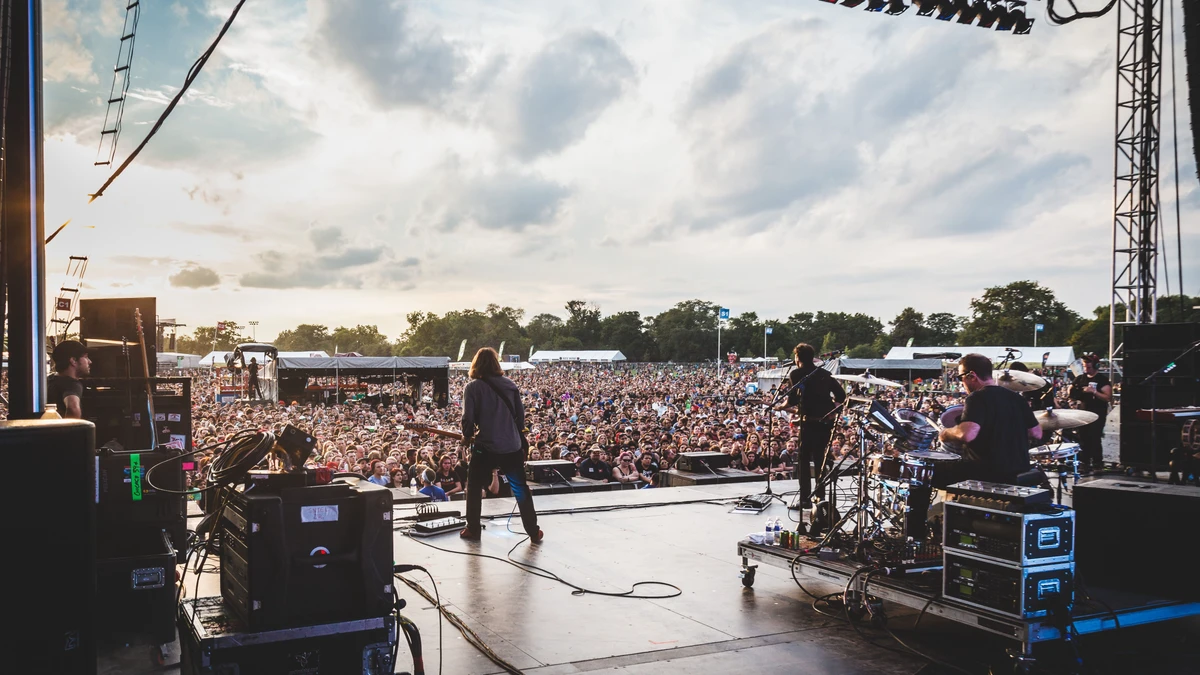
Jimmy Eat World performing to a festival crowd.
Jimmy Eat World performing to a festival crowd.
Jimmy Eat World are playing every stop of the revived Warped Tour this year, in four countries.
They were the first act announced, and the last time they played it was twenty-five years ago.
Five Stops, Four Countries
The revived tour is a small number of two-day events rather than the travelling caravan it used to be.
That is a fundamental change of format. The original ran through dozens of American cities across a summer, functioning as a mobile festival that reached secondary markets no festival otherwise served.
Five destination events in Washington, California, Montreal, Mexico City and Florida is a different proposition entirely, closer to a festival brand than to a tour.
Playing all five, in four countries across six months, is a serious commitment for a band that could reasonably have done one.
Being the First Announcement
They were named before any other act, with the rest of the bill revealed later.
The first announcement of a festival does a specific job: it establishes what kind of event this will be and gives everybody an idea of the tier it is aiming at.
Choosing a band that played the original in its first era, and whose biggest album turns twenty-five in the same year, is about as clear a statement of intent as the organisers could have made.
What Warped Tour Actually Was
The original ran through most summers from the mid-1990s, and its significance is easy to understate now.
It was the primary distribution channel for punk, emo and hardcore in North America for roughly fifteen years, and it reached teenagers in places no other music infrastructure did.
An enormous number of the bands still touring this circuit were seen for the first time by their current audience in a car park in the afternoon heat, which is why its return is treated as an event rather than a nostalgia exercise.
Twenty-Five Years Between Appearances
The band last played it in the early 2000s, at the point where their commercial position changed.
Bands that break out of a scene generally stop playing that scene’s festivals, because the economics stop working and because a mainstream audience arrives that does not overlap with it.
Returning after a quarter of a century closes a loop that most successful bands never bother to close.
An Album That Reached Radio
The record being celebrated came out in 2001 and did something almost nothing from that scene managed, which was reach mainstream American radio.
The singer has described it as the thing that changed their lives and gave them a new, broad audience, which is an unusually straightforward account of what a hit does.
A crossover of that kind is a permanent inflection point. Everything before it is the band’s history and everything after happens in front of an audience that arrived for one song.
Why Those Songs Worked on Radio
The construction is melodic rock rather than punk, and the difference is entirely audible.
Choruses arrive early and repeat, the melodies sit in a range an ordinary person can sing, and the guitar parts are hooks rather than riffs, functioning as second melodies that a listener remembers separately from the vocal.
That is the same craft that put guitar bands on radio in every previous decade, applied to a scene that had mostly rejected it.
Guitar Hooks You Can Hum
The band’s signature is a specific kind of clean, bright, repeated guitar figure.
Those parts do work that a rhythm guitar cannot. A memorable instrumental phrase gives a song a second identity, so it is recognisable from four bars of introduction before anybody sings.
Bands who write that way get played on radio, because programme directors need songs a listener can identify instantly, and it is why this band’s catalogue has held its place on playlists for two decades.
The Biggest British Show of Their Career
Three British dates in August include what the band describe as their largest headline show in that country.
British audiences for American emo have grown substantially in the last decade, driven by a younger generation discovering the records long after the fact.
That is why bands from this scene are now playing bigger British rooms than they did at their commercial peak, which is a genuinely unusual career shape.
Arizona Rather Than a Coast
The band formed in Arizona, a long way from the label and press infrastructure of either American coast.
Isolation of that kind slows a band down early and tends to produce a more distinctive result, since there is no local scene to sound like.
It also means the early audience was built by touring, which is the durable way to do it and the reason a band from there can still fill rooms thirty years later.
Seven Years Without an Album
The last studio record came out in 2019, and the singer has said there is material but nothing ready to release.
That is an honest answer and an increasingly common position. A band with a catalogue this size and a touring schedule this full has no commercial pressure to release anything.
The risk is that the gap becomes permanent by default, which is how a working band quietly turns into a catalogue act without anybody deciding to.
Gratitude as a Stated Approach
Both the singer and the drummer have framed this run around appreciating an audience that has sustained them for twenty-five years.
The singer’s phrasing was about getting back to a place where you can savour things, which is a specific and slightly unusual thing for a musician to say publicly.
It also reflects something real about the difference between a first success, which happens too fast to process, and a later one, which does not.
Why a Festival Brand Came Back
The revival of a defunct touring festival is a business decision worth understanding, because several are happening at once.
The audience that attended these events between 1995 and 2010 is now in its thirties and forties, with money and a strong attachment to a specific period of its life. That is the most valuable demographic in live music and it is being served almost entirely by nostalgia.
What has changed is the format. The original model of forty cities in a summer is no longer economically viable, since production costs, crew wages and fuel have risen far faster than ticket prices. A handful of large destination events in fixed locations solves that, at the cost of the thing that made the original matter, which was that it came to you.
Whether that trade holds is the open question, and the answer will determine how many more of these revivals happen.
What an Anniversary Does to a Band Still Working
Celebrating a twenty-five-year-old record is straightforward for a band that has stopped and complicated for one that has not.
A full year built around one album tells an audience that this is the important thing, which is difficult to walk back when the next record arrives. It also fixes the band in 2001 in the minds of everybody who buys a ticket.
The bands who handle it well treat the anniversary as one project among several rather than as an identity, and keep enough non-anniversary activity visible that nobody assumes the catalogue is closed.
The unreleased material the singer has mentioned matters more than it appears for exactly this reason. It is the evidence that the anniversary is a year rather than a destination.
What Is Actually Being Tested
Two things. Whether a revived festival built on five destination events can mean what a travelling one meant.
And whether a band celebrating a twenty-five-year-old album still turns the beginnings of new material into a record.
Five stops, four countries, twenty-five years, and the biggest British show they have played.
About The Author