
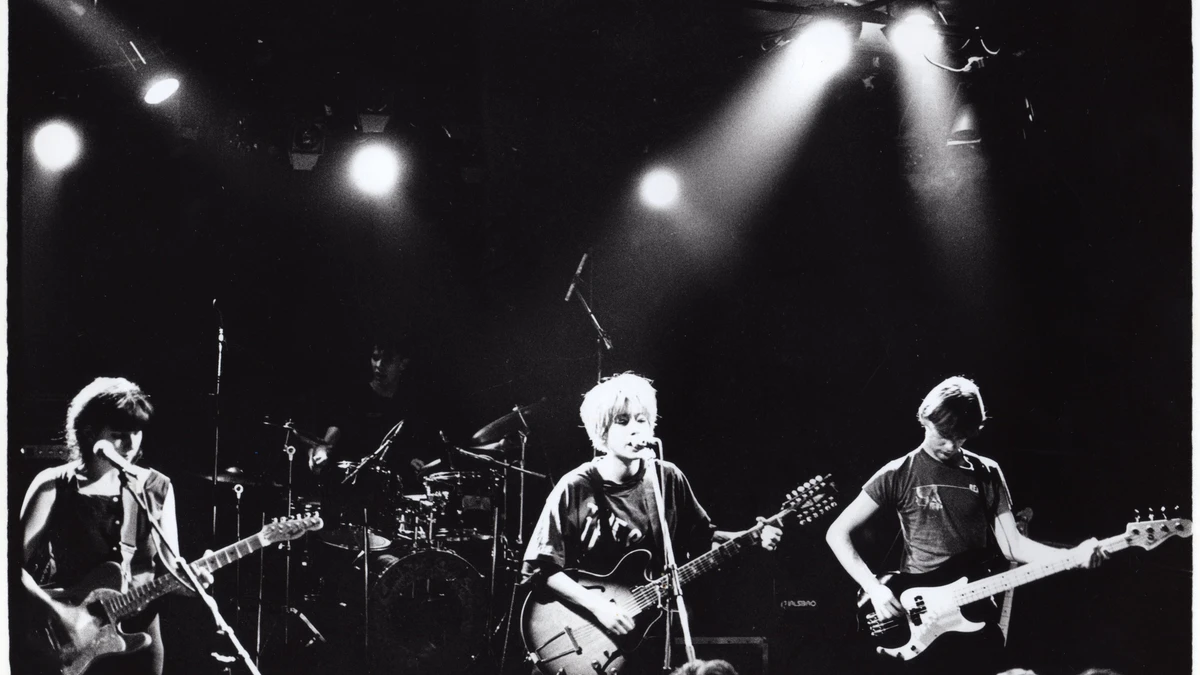
Lush performing in 1990, with the original line-up.
Lush performing in 1990, with the original line-up.
Lush were among the very first bands anybody applied the word shoegaze to.
They started as two school friends with a fanzine and ended twice.
Being Named Before the Genre Was
The word was coined by the British press in the late 1980s as an insult, describing bands who stood still and looked down at their effects pedals.
Being among the first acts labelled that way is a strange historical position. The band did not choose the term, did not like it, and are now permanently filed under it.
What the label described accurately was a genuine shift in what a guitar band was for: performing a sound rather than a personality, with no stagecraft because none was relevant.
Thirty-five years later the word has lost its sting entirely and is used by young bands as a self-description, which is what happens to almost every insult a scene adopts.
Two School Friends and a Fanzine
The two founders had known each other since school and published a fanzine together before either played in a band.
That order matters. People who write about music before making it tend to arrive with a formed set of opinions about what is good, which is a different starting point from learning an instrument and working out what to do with it.
Fanzine culture in that era was also a functioning network. It connected people across cities, got writers into venues, and produced a substantial number of musicians who had spent years thinking about records before making one.
Two Guitars, Two Voices
Both founders played guitar and both sang, which is unusual and shaped everything about how the records sound.
Two guitarists who are both writing produce arrangements that interlock rather than divide into lead and rhythm, and two voices allow harmony that is genuinely two people rather than one person doubled.
It also means the songwriting was shared rather than centralised, which produces more variety across an album and considerably more scope for disagreement.
Melody Inside the Reverb
The records are frequently described in terms of texture, which undersells how much conventional songwriting is underneath.
The melodies are clear, the harmonies are close, and the vocal writing owes more to 1960s pop than to anything from the era the band came out of.
That combination, of pop melody buried inside processed guitar, is the defining structure of the whole genre, and it is why these records remain listenable rather than merely historically significant.
Pedals as the Instrument
The guitar sound in this music is produced by effects rather than by playing technique.
Reverb creates space, delay creates repetition, chorus and flange create movement, and stacking them turns a straightforward chord into something that behaves less like a guitar and more like weather.
The skill involved is in the ordering and the settings rather than in the fingers, which is precisely why the bands stood still and looked down.
An Ending Nobody Chose
The band stopped in 1996 following the death of their drummer, which is a different kind of ending from a break-up.
Bands that split over musical differences or exhaustion can reconvene later and frequently do. A band that stops because a member has died faces something that cannot be resolved by anybody changing their mind.
They had just released their third album, which had been their most commercially successful, which makes the ending more abrupt than most.
A Reunion Two Decades Later
The band returned briefly in 2015 and 2016 with three of the four members and a new drummer, touring and recording an EP.
Coming back after nineteen years is a substantial decision, and returning with new material rather than only the catalogue is the harder version of it.
The reunion then ended, which is a normal outcome. A short return that produces something and stops is a considerably better result than one that continues past its usefulness.
Ending a Second Time
Second endings are difficult to explain publicly, because the first one already used up the available narrative.
What tends to be true is that the conditions that made the original band work were specific to a moment, and a reunion recreates the personnel without recreating those conditions.
Members who have run separate lives for two decades bring different expectations to a rehearsal room, and it is a genuinely hard thing to negotiate.
Two Careers Afterwards
Both founders have continued separately, one with a band and then a trio, the other with a solo album released in 2023.
Parallel careers from one former band are common and the results are usually informative, because they show which parts of the original sound belonged to which person.
It also means the catalogue has two ongoing custodians rather than one, which is a healthier situation for the legacy than a single member touring the name.
Writing the Book
One of the founders published a memoir about the band and the industry around it.
Musician memoirs from this era have become a substantial genre, and the ones written by people who were not the biggest act in the room tend to be the most useful.
An account from inside a band that was significant, moderately successful and not enormous describes what the music industry of that period was actually like for most of the people in it.
What the British Press Did to That Scene
The weekly music papers of the late 1980s and early 1990s had enormous power and used it in a specific way.
They created scenes by naming them, which gave bands visibility they could not otherwise have got. They then dismantled those scenes within two or three years, because a weekly publication needs a new movement far more often than music produces one.
Bands caught in that cycle were promoted intensively and then written off as unfashionable while still in their twenties, having done nothing differently. Several careers ended for reasons that had nothing to do with the records.
The shoegaze acts were among the most obvious casualties, dismissed almost overnight when the press turned toward a louder and more sociable British scene. That the genre’s reputation recovered completely thirty years later, driven by listeners rather than critics, is the clearest possible verdict on how that judgment was made.
Why Originators Get Rediscovered
This band’s audience is now substantially younger than the records, which is the standard fate of a genre that is revived.
The mechanism is consistent. A younger band cites an influence, listeners work backwards, and the streaming catalogue makes the entire discography available instantly in a way that would have required a specialist record shop in 1994.
What that produces is an odd asymmetry. The rediscovered band gets an audience it never had at the time, arriving too late to change anything commercially, and frequently after the band has stopped existing.
The compensation is that the records get judged on what they are rather than on what the press thought of them that month, which is the only fair hearing music from a hyped scene ever gets.
What Is Actually Being Tested
Two things. Whether a catalogue of three albums and a handful of EPs holds up as the genre it helped define keeps producing new bands.
And whether two separate careers built from one band eventually say more about the original than the original did.
Three albums, one fanzine, two endings, and a word they never wanted.
About The Author