
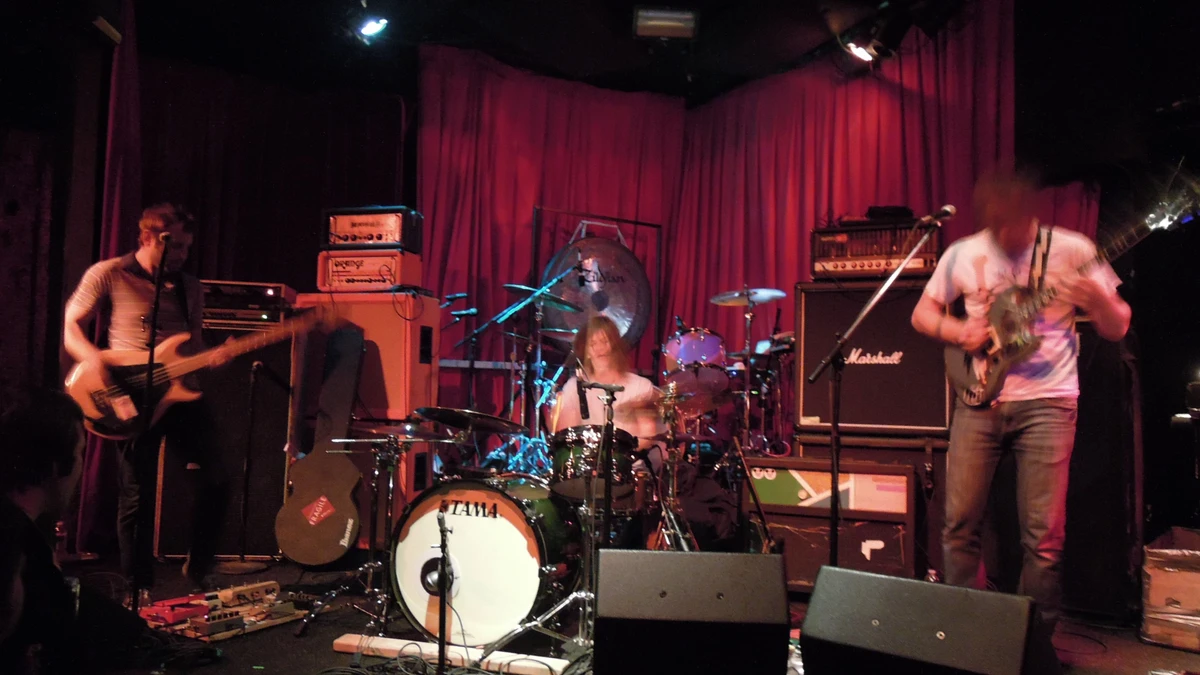
Tera Melos performing live.
Tera Melos performing live.
Tera Melos spent nearly a year rehearsing before they played to anybody.
They were looking for a singer at the time and never found one.
A Year in a Room
Almost no band does this. The normal sequence is to learn four songs badly and book a show, because playing live is how a band works out what it is.
Twelve months of rehearsal before a debut suggests a group that knew exactly what it wanted to sound like and was not willing to be heard until it did.
For music this rhythmically complicated, there is also a practical argument. Start-stop arrangements and shifting metres do not survive being half-learned, and a band that plays them approximately sounds like a band making mistakes.
The cost is everything a year of shows would have taught them, which is a genuine trade rather than obviously the right call.
Instrumental by Accident
The band intended to recruit a vocalist and simply never settled on one.
That is a considerably more common origin for instrumental bands than the romantic version, in which a group decides that words would compromise the music.
What tends to happen is that the search takes months, the material develops without a voice in it, and eventually the songs no longer have anywhere obvious to put one.
Vocals Arriving Later
Prominent vocals first appeared on a split release two years after the debut, and have been part of the sound since.
Adding a voice to established instrumental material is difficult, because every space a singer would normally occupy is already filled by a guitar part.
Bands who manage it usually do so by writing differently rather than by singing over what already exists, which is a genuine change of method rather than an addition.
Start, Stop, Start Again
The defining characteristic of the arrangements is abrupt change: a passage stops entirely and something unrelated begins.
That is a deliberate refusal of the thing rock music normally provides, which is momentum. A groove that never establishes itself cannot be settled into.
Done badly it is exhausting and arbitrary. Done well it keeps a listener permanently slightly off balance, which is the effect the whole genre is built on.
Improvisation Inside Written Music
The band leave sections open rather than fixing every part, which is unusual for music this precisely composed.
Extended open-ended bridges mean the recorded version is one possible outcome rather than the definitive one, and the live versions differ substantially.
That requires a level of communication between three players that only comes from years together, which is presumably part of what a year of rehearsal was buying.
A Floor Covered in Pedals
The guitar sound depends heavily on effects, with a pedalboard large enough to be a visible feature of the stage.
Pedals in this context are not producing tones so much as producing events: sudden pitch shifts, stutters, reversals and delays that function as compositional moves rather than as textures.
That is a genuinely different use of the technology from most rock guitar, where effects are chosen once and left alone for a whole set.
Samplers Alongside Guitars
The band use samplers as well as pedals, which places them closer to electronic music than the instrumentation suggests.
A sampler in a live rock band introduces material nobody is playing, which complicates the timing enormously and expands what three people can produce.
It also means the arrangements can include sounds that have no acoustic source at all, which is why these records do not sound like a trio.
Two Hands on the Neck
Tapping is central to the guitar playing, with both hands on the fretboard producing independent lines.
That technique is close to universal in this genre now and it was considerably less common when this band started, in the mid-2000s.
Its usefulness is straightforward: one player can produce a bass figure and a melody simultaneously, which is how a three-piece covers arrangements written for more.
Sacramento Rather Than the Bay
The band come from Sacramento, roughly ninety miles from a considerably more famous music city.
Being near a major scene without being in it is a specific position. The infrastructure is reachable but the local competition, rent and pressure to conform are all lower.
Bands from cities like that tend to sound less like anybody else, because there is no dominant local style to belong to.
A Long Relationship With One Label
Most of the catalogue has come out through the same American independent, which reissued the debut several years after it first appeared.
Reissuing an early self-released record is one of the more useful things a label does for a band, since it puts the beginning of the catalogue back in circulation with proper distribution.
For a group whose first album was instrumental and largely overlooked, that second chance matters more than it would for most.
A Drummer Who Changed the Band
The current drummer joined four years in, after a six-month search, and has been there ever since.
Replacing a drummer in a band built on rhythmic complexity is not a routine substitution. The parts are difficult, the arrangements depend on precise timing, and the feel of the whole group changes with the person playing them.
Six months is a long search and it suggests the band understood exactly how much depended on getting it right.
Why Math Rock Bands Take So Long
The genre has an unusually slow release rate, and the reasons are structural rather than temperamental.
Writing a piece in shifting metres with independent parts for three or four instruments is closer to composition than to jamming, and it cannot be done quickly. A conventional rock song can be written in an afternoon by four people in a room; a piece of this kind is assembled over weeks.
Learning it takes almost as long. Every member has to internalise a part that does not repeat predictably, and a rehearsal that would get a normal band through a whole set covers one piece here.
The consequence is visible across the whole scene: small catalogues, long gaps, and bands that remain active for two decades with four or five albums to show for it. That is not a lack of productivity. It is what the music costs.
What Being Overlooked Early Buys You
The debut was named one of the most overlooked records of its year, which is a backhanded honour and a useful one.
A band ignored on its first record is not asked to repeat it. There is no signature sound to protect, no audience expecting a particular thing, and no commercial pressure attached to the next release.
That freedom is why so many bands’ second and third albums are their most adventurous, and why an early success can be more limiting than an early failure.
The catch is that it only works if the band survives long enough to use it, which requires an income from somewhere and a tolerance for playing to small rooms for several years.
What Is Actually Being Tested
Two things. Whether a band that spent a year preparing to be heard still has that much patience two decades on.
And whether music built on refusing momentum keeps finding new ways to refuse it, or eventually becomes its own kind of pattern.
Twenty years, three members, one year of rehearsal, and a singer they never found.
About The Author