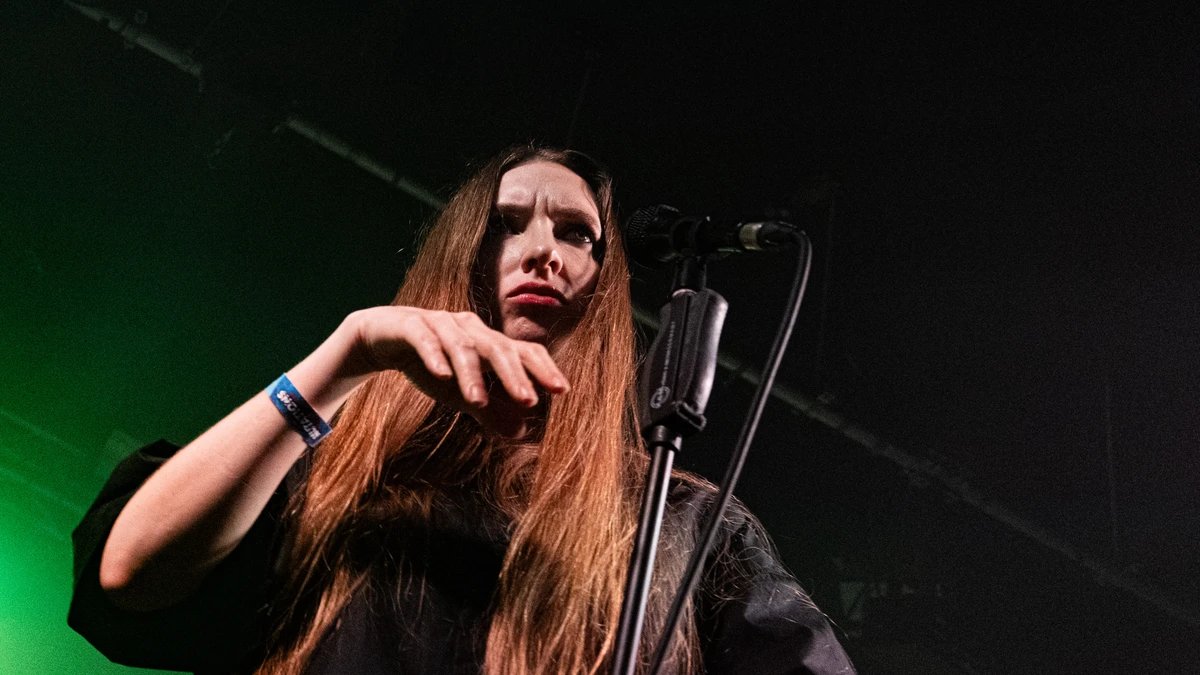
For two albums Dry Cleaning were the band whose singer did not sing. On the third, she does — and the person who talked her into it was not in the band.
Secret Love arrived on 9 January through 4AD, running forty-one minutes and one second. It is the first Dry Cleaning record not produced by John Parish, and the difference announces itself inside the opening track.
The First Album Without John Parish
Parish produced New Long Leg in 2021 and Stumpwork in 2022, the two records that established what a Dry Cleaning song sounds like. For the third, the band decided they would benefit from working with somebody else.
The reason Florence Shaw gave was social rather than artistic, which is more interesting than a falling-out would have been. Speaking to Mojo in December 2025, she said: “When New Long Leg came out, it was a very insular world. Its recording was quarantine-sensitive — we were all in a bubble with John … That kind of atmosphere was still weighing quite heavily on the process, even on our second record. So beyond just meeting other musicians at festivals, we wanted to see what actually working with people would be like.”
That is a band describing two albums made in a closed loop and deciding the loop was the problem. Not the producer, not the method — the isolation around both.
More than three years passed between Stumpwork and this one, which is a long gap for a band who had been touring almost continuously through it. Some of that time went on the search itself.
A Backstage Introduction in Chicago
The producer they found came out of exactly the kind of encounter Shaw had described wanting more of. After playing Chicago’s Pitchfork Music Festival in 2022, the band were greeted backstage by Jeff Tweedy of Wilco, a fan, who invited them to visit his nearby studio, The Loft.
Wilco were recording Cousin there at the time, produced by the Welsh musician Cate Le Bon, who was also present. Shaw had known Le Bon’s production work for years; nobody in Dry Cleaning had met her until that afternoon.
By 2024 the band were considering their next record, but 4AD chose to reissue their early EPs and they kept touring instead. In the summer they returned to Peckham to begin writing, and bassist Lewis Maynard noted that revisiting that early material had a direct effect: “It pushed us into more interesting directions.”
They then demoed the album across several studios — The Loft in Chicago among them, and Gilla Band’s Sonic Studios in Dublin — before settling on Le Bon as producer and re-recording almost all of it with her at Black Box Studios in the Loire Valley in mid-2025. Recording ran from June 2024 to May 2025.
Making a full set of demos and then substantially starting again is expensive in time and morale, and few bands three albums in would agree to it. It is the clearest evidence that the producer search was not a formality.
The Instruction That Changed the Guitars
Le Bon’s method appears to have been to remove options rather than add them. She urged guitarist Tom Dowse to avoid using his SG during recording, so he played other instruments instead.
For much of the harsher material he used a Danelectro 1449 that had caught his attention during the band’s time at The Loft in Chicago, usually through a Hiwatt amplifier with a third-version Expandora pedal he had picked up in Japan.
Taking a guitarist’s main instrument away is a blunt intervention and a revealing one. A player’s habits live in the guitar he reaches for — the shapes his hands default to, the tones he already knows how to get. Swap it and the writing has to move whether he intends it to or not.
The same approach reached the vocals. Le Bon encouraged Shaw to sing rather than speak when the lyrics were more emotionally driven, which is how the title track “Secret Love (Concealed in a Drawing of a Boy)” and “I Need You” ended up sung.
Reviewing it for Clash, Igor Bannikov identified the chorus on the opening track as the band’s “first proper chorus ever” and heard the title track as “almost French chanson-esque”. Set against Shaw’s tentative moves away from talk-rock on Stumpwork, he called it “a huge leap forward”.
It is worth being precise about the scale of the change. Shaw still relies heavily on spoken word across the record; the singing arrives at the choruses, where a spoken vocal has the least to offer.
Six Minutes of Funk to Open With
The album opens with “Hit My Head All Day”, six minutes long and the lengthiest track by a considerable margin. It is a funk song, built on drum loops and bongos from Nick Buxton and a groove-oriented bassline, with synthesisers arriving in the final third.
Critics have reached for David Bowie’s Scary Monsters period and for Robert Fripp-adjacent guitar parts to describe it. When the band demoed it they were drawing on Sly and the Family Stone’s There’s a Riot Goin’ On; the lyric concerns a narrator seeking stimulation who embraces being manipulated by misinformation circulating in online echo chambers, while recalling the innocence of childhood.
Bannikov put the audacity plainly: “Not everyone can afford to open a record with a six-minute-long Talk Talk-ish new wave-inspired epic like ‘Hit My Head All Day’, while Dry Cleaning do that with the ease of guitar music bigwigs.”
Elsewhere the reference points are older still. “Cruise Ship Designer” took its guitar playing from Keith Richards on the Rolling Stones’ Sticky Fingers, and Tweedy contributes additional guitar to “My Soul/Half Pint” — the Chicago introduction eventually turning up on the record itself.
In The Guardian, Alexis Petridis singled out a line from that song — “I make sure there are hidden messages in my work” — and noted it is delivered not by Shaw but through the song’s self-regarding protagonist, mocking the idea of larding your work with hidden messages as hopelessly pretentious.
What the Reviews Made of It
The notices were strong enough to be worth listing. The album holds a Metacritic score of 87, with five out of five from Mojo, four and a half from AllMusic, nine out of ten from Clash, and four out of five from both DIY and The Guardian.
Petridis’s headline described the band doubling down on their “haunting, peculiar brilliance”, and his paper framed them as the standout act in the sprechgesang wave, carrying Shaw’s tales of mundane lives spiralling out of control on a newly expansive sound.
Clash was blunter, calling the record “a fresh take on the old talk-rock formula that turns into an instant classic right before your ears” and crediting Le Bon with directing the band toward a more lush and textured sound.
Commercially it did what a well-reviewed independent record does. It entered the UK Albums Chart at number 12, went higher in Scotland at 4 and reached 3 on the UK independent chart, with top-40 placings in Australia and New Zealand at 34 and 28.
An 87 on a third album is a genuinely unusual result. Third albums are ordinarily where a distinctive method hardens into a formula, and Dry Cleaning had a method distinctive enough to be at real risk of it. Shaw told Clash the band are “very confident about our identity” and that “it doesn’t seem to be possible to break it down” — which is precisely the position from which a band can afford to try what Buxton described as “radically different things”.
The Tour Had to Move
The 2026 tour opened on 3 January at the Rockaway Beach Festival in Bognor Regis, with North American dates scheduled from late January into February.
Those did not survive. Announcing their third single in December 2025, the band said the North American leg was being rescheduled, citing “a number of factors, not least of which the increasingly hostile economic forces that govern touring in the present day”. Most of the dates moved to late April and May.
That is a band with an 87 Metacritic score and a UK top-20 album finding a winter North American run financially unworkable. It says nothing about the record and a great deal about the conditions around it. Our piece on the support slot economy covers the arithmetic further down the same bill.
The rescheduled run began on 7 April at Festsaal Kreuzberg in Berlin and continues to 31 July at the All Together Now festival in Curraghmore, Ireland, with support across the dates from Hotline TNT, Jerkcurb, Snõõper, the Tubs and YHWH Nailgun among others.
The record has kept growing meanwhile. “Sliced by a Fingernail”, an outtake from the Le Bon sessions, appeared as a standalone single in late March, and a digital deluxe edition followed on 14 July adding it alongside two further session tracks, “Grass” and “I Have the Key”. A vinyl edition is scheduled for 16 October through Dinked.
Producer changes are usually defensive moves, made when something has stopped working. This one was made from a position of confidence, by a band who did not think their identity could be dismantled, and it produced the least predictable record they have.
Secret Love is out now on 4AD.
About The Author