Fontaines D.C. announced their fifth album on a Saturday. On the Monday they put a first pressing on sale. The lead single arrived on the Tuesday.
Dopamine Chamber is out on 16 October through XL Recordings, eleven tracks running forty-three minutes and fifty-nine seconds, produced by James Ford.
The Record Came Before the Song
That sequence is worth laying out properly because it inverts the standard order. The title was revealed on 15 August alongside a twenty-six-second teaser of the opening track, “Six Shot Morning”. On 17 August an exclusive first pressing went on sale on vinyl. On 18 August the single “Marianne” appeared, and the release date was confirmed with it.
Normally a single introduces an album and the physical formats are ordered weeks later, once demand has been demonstrated. Here the object was available before the audience had heard a complete song from it.
That only works for a band whose audience will buy on trust, which is the point of doing it. An exclusive first pressing sold on a title and a twenty-six-second clip is a direct measurement of how many people are committed regardless of what the record turns out to be.
It is also an old idea in modern clothing. Pre-orders on the strength of a name are how records were sold before streaming made the music free to hear in advance, and vinyl is the one format where that logic still holds. Our piece on what happened to the record shop listening post covers what changed when hearing a record before buying it became automatic.
They Played the Songs Before Anyone Knew
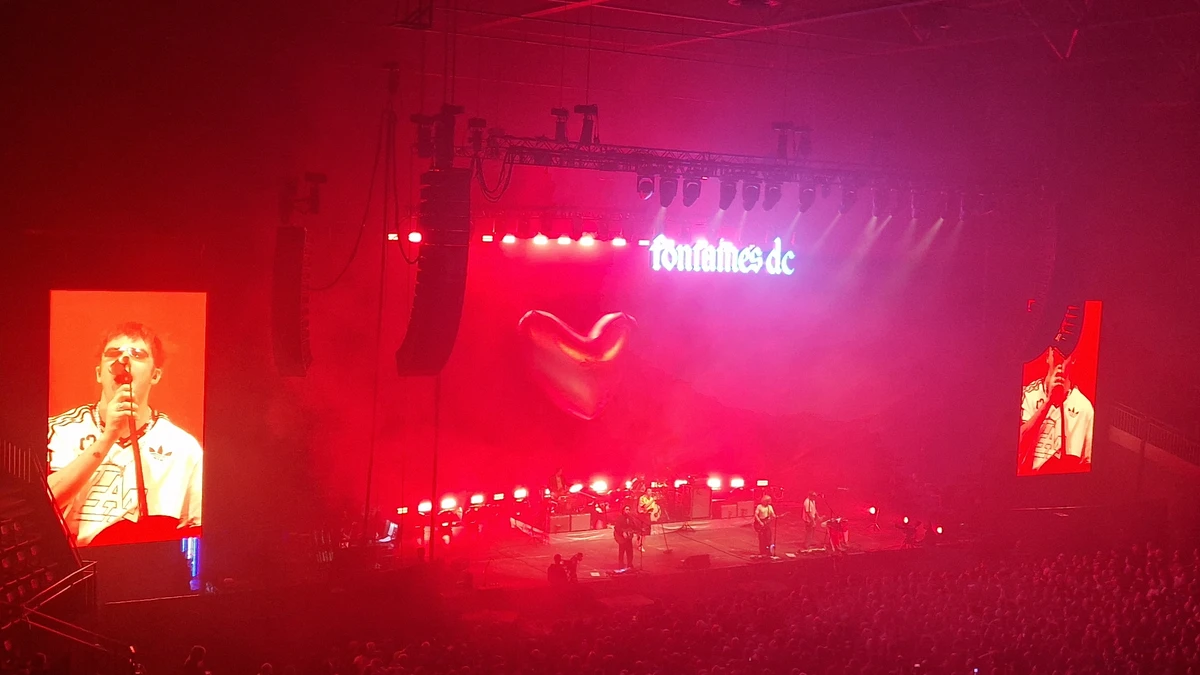
The songs had actually been public for weeks by then, just not on record. The band returned to live performance in summer 2026 with a run of shows in Cadiz, and those dates saw the debut of both “Marianne” and “Six Shot Morning”.
Debuting an album’s opener and its lead single at a small run of Spanish shows, before any announcement, means the first people to hear the record were in a room rather than on a phone.
It is a low-risk way to test material — a Spanish audience, no press, no formal announcement — and a high-trust one, since anything played live now circulates within hours whether the band want it to or not.
The preparation around it was more conventional. In August the band overhauled their online presence, introducing a new logo, a newsletter and a new press image built around the number five.
Thirteen Months of Recording
The record was made across a long window: February 2025 to March 2026. That is thirteen months, and it followed immediately from the touring cycle for Romance.
The band were writing before the tour had properly settled. In February 2025 they told NME they had started on new material and could not stop writing, with Deegan describing some songs as having “a feel to them” while others were “more loose”, and the direction not yet decided.
A year later, in January 2026, Carlos O’Connell described the process simply as “fun” — which for a band four albums deep, immediately after a commercially successful one, is a more informative word than it looks.
The pressure after a breakthrough usually produces the opposite report. Romance was widely acclaimed and commercially successful, and the standard follow-up account involves difficulty, second-guessing and a producer brought in to impose a direction.
The Same Producer, Again
Instead they kept the one they had. James Ford produced Romance and produced this, and also handled the mixing.
Repeating a producer after a successful album is the conservative choice and, on the evidence of the writing timeline, a deliberate one. A band who could not stop writing did not need somebody to help them find material; they needed somebody who already understood what the material was for.
The engineering credits are unusually deep for a rock record — Eva Valentine, Evie Clark-Yospa, Marta Salogni, Robert Sellens and Madison Claridge, with Matt Colton mastering. Five engineers across thirteen months suggests sessions in more than one place and at more than one point.
Authorship stayed collective. All eleven tracks are credited to Grian Chatten, Carlos O’Connell, Connor Curley, Deegan and Tom Coll — the full band, on every song, with no outside writers.
Three Synthesisers and a Strings Arrangement
The instrument credits are the most revealing part of the personnel list. O’Connell plays guitar and synthesiser, Curley plays guitar and synthesiser, and Coll plays drums and synthesiser.
Three of five members handling synths is a long way from where this band started. Fontaines D.C. arrived as a guitar group inside a post-punk revival defined largely by what it refused — no keyboards, no gloss, no production beyond what a room could produce.
Chatten is credited with lead vocals, percussion, guitar and strings arranging, which is the other significant line. A singer arranging strings is doing compositional work outside the band format entirely, and it is not a role anybody takes on by accident.
Read alongside the album title, the direction is fairly clear. A record called Dopamine Chamber, made by a guitar band who have collectively picked up synthesisers and started writing string parts, is not aiming at the sound that made them.
Following a Breakthrough
The position they are in explains some of the caution in the rollout. Romance arrived in August 2024, was widely acclaimed, sold well, and carried the band through a long touring cycle including North American dates.
A band coming off that has two problems at once. The audience has grown faster than the catalogue, so a large share of listeners know one album; and the expectations attached to the next record are set by people who were not there for the first three.
Announcing quietly, selling to the committed first and releasing a single second is one answer to that. It serves the existing audience before the wider one, and it means the record’s first measurement comes from people who were already in.
Eleven Tracks and Nothing Wasted
The tracklist is compact and evenly weighted. “Six Shot Morning” opens at 4:56 and “Where Is Gone?” is the longest at 5:16; everything else sits between three and four minutes.
In sequence: “Six Shot Morning”, “Marianne”, “Mimesis”, “Happy for You”, “Demolition”, “Tongue”, “One Man”, “Where Is Gone?”, “You Miss Me”, “Japan” and “Intimate”.
Forty-four minutes across eleven songs is close to the classic album length, and it is a decision with consequences. There is no room for interludes, no deluxe padding and no obvious candidate for deletion — every track has to justify its place.
The titles suggest a narrower emotional field than the album before. “Mimesis”, “Happy for You”, “You Miss Me”, “Intimate” — these are relational rather than atmospheric, which for a band whose earlier work drew heavily on place and city is a shift worth watching.
What the Rollout Tells You
Read together, the four days between 15 and 18 August describe a band confident enough to sell first and explain later.
A new logo, a press image organised around a number, a title dropped with a twenty-six-second clip, vinyl on sale two days later, then a single. Nothing in that order is accidental, and none of it depends on radio or on a playlist placement.
It is the rollout of a band who have concluded that their audience is the distribution channel. Whether the record earns that confidence is a question for October.
Dopamine Chamber is out on 16 October through XL Recordings.
About The Author