
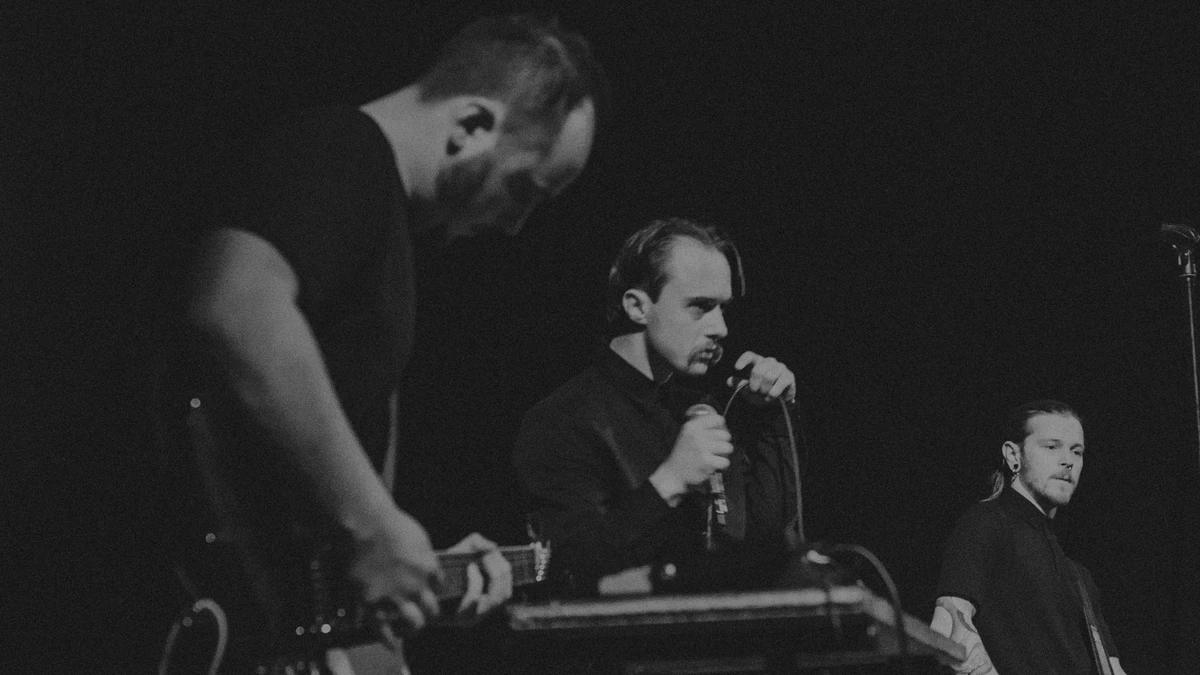
Molchat Doma performing live.
Molchat Doma performing live.
Molchat Doma reached most of their first audience through a YouTube channel that had nothing to do with them.
Somebody uploaded their second album. Two million people listened to it there.
An Audience Built by a Stranger
The band self-released a debut in 2017 and put out a second album through a small German independent the following year.
Neither had any promotional machinery behind it. What happened instead was that a listener uploaded the record to YouTube, alongside other bands working in the same style, and it found an audience there.
By the end of 2019 that upload had brought the album to roughly two million listeners, which is an entirely different order of magnitude from what the label could have delivered.
It is worth being precise about what that means: the band’s career was substantially built by somebody they had never met, using a copy of a record they did not authorise.
Why That Only Works for Certain Music
Unofficial uploads are common and almost never do this, which makes the mechanism worth examining.
What made it work here is that the channel functioned as a curator rather than a pirate. It grouped bands by sound, so a listener who arrived for one act was immediately offered several more in the same style.
That is precisely what a genre-defined audience wants and what platform recommendation systems are bad at supplying, and it explains why a small scene can be assembled by one person with a good ear and no budget.
Popular Everywhere Except Home
The band sold out shows across Europe well before they were widely known in their own country.
Inversions of that kind are more common than they look, particularly for bands singing in a language that reads as exotic abroad and ordinary at home.
The members have also been publicly uninterested in the large home-city arena that would represent domestic arrival, which is an unusual thing to say out loud and a clarifying one.
Singing in Russian to a Global Audience
The lyrics are in Russian, which conventional industry logic says should cap an act’s reach.
That logic has been wrong for a decade. A substantial share of the current global audience listens to music in languages it does not speak, treating the voice as another instrument and the meaning as optional.
For music built on atmosphere rather than on argument, a language barrier can even help, since it removes the possibility of a lyric spoiling the mood by being clumsy.
Where Coldwave Comes From
The style is usually described as coldwave, which is a specific corner of post-punk rather than a synonym for it.
The markers are consistent: drum machines rather than a drummer, synthesisers carrying the harmony, bass playing the melodic role, and a vocal delivered flat and low.
The emotional register is deliberately withheld. Nothing builds, nothing releases, and the effect comes from repetition and from what the arrangement refuses to do.
Bass and Drum Machine as the Engine
The structural centre of this music is the relationship between a programmed drum pattern and a bass line, which is straight post-punk construction.
A drum machine does not breathe. It plays the same pattern at the same velocity indefinitely, which removes every human variation that normally makes a rhythm section interesting.
What that leaves is the bass, which has to carry the movement, the melody and the feel all at once. It is why bass players in this genre are doing considerably more work than the arrangements suggest.
Guitar as Texture
The guitar in these records is not playing riffs, and that is a genre convention rather than a limitation.
It provides high, thin, heavily processed lines that sit above the synthesisers, closer to an atmospheric layer than to a lead instrument.
That division of labour comes directly from British post-punk at the turn of the 1980s, where guitarists reacted against the previous decade by playing as little as possible.
An American Label and a Reissue Campaign
In 2020 they signed to an American independent, which reissued the first two albums and gave them their first North American releases.
Reissuing an existing catalogue is the standard first move when a label signs an act with an audience it did not build, because the demand already exists and the recordings are made.
It also converts an audience that had been listening for free into one that can buy something, which is the entire commercial problem such a band starts with.
Leaving Minsk
The most recent album was written and recorded in Los Angeles, after the band relocated from Minsk.
Moving continents is a substantial disruption for any group, and for one whose music is closely associated with a specific place and climate it raises an obvious question about what happens to the sound.
The record continued in the same style, which suggests the aesthetic was never a straightforward reflection of the surroundings so much as a deliberate construction that travels.
Sixty Dates in One Cycle
The album was promoted with a sixty-date world tour, which is a serious commitment for a band of this size.
Sixty shows across multiple continents is the schedule of an act with genuine international demand rather than one testing a few markets.
It also reflects where the audience actually is. A band whose listeners were assembled online are distributed globally rather than concentrated in one country, which makes long international routing the only way to reach them.
Four Albums in Seven Years
The catalogue runs to four studio albums released between 2017 and 2024.
The first three came quickly and the fourth took four years, which is the shape produced by a band that becomes successful mid-career and has to fit writing around touring.
Gaps of that length are risky for an act whose audience arrived through algorithmic discovery, since those listeners are notoriously easy to lose and the tour is the main thing keeping them engaged.
What Happens When the Platform Made You
A career built on an unofficial upload leaves a band in a structurally strange position, and it is worth setting out.
The audience was not assembled by the band, by a label or by a press campaign. It was assembled by a recommendation engine responding to one person’s uploads, which means nobody involved has a repeatable method for doing it again.
That is the uncomfortable part. A band that broke through conventionally knows which levers were pulled and can pull them again. A band that was discovered has no equivalent knowledge, and every subsequent release is an attempt to hold an audience whose arrival was never fully explained.
What tends to work is exactly what this band has done: sign to a label that can convert attention into sales, tour relentlessly to convert listeners into ticket buyers, and build a direct relationship that does not depend on any platform continuing to recommend you.
Why Coldwave Suits the Present
The style has had a substantial revival, and the reasons are worth naming beyond fashion.
The music is cheap to make. A drum machine, a synthesiser, a bass and a guitar can be recorded in a bedroom, and the aesthetic actively rewards the slight cheapness that a home recording produces. Nothing about it requires a studio budget.
It also suits how a great deal of music is now consumed, which is on headphones, alone, as an accompaniment to something else. Music built on repetition and atmosphere works far better in that context than music built on dynamics and payoff.
That combination of low production cost and high compatibility with modern listening habits is why a genre from 1981 is producing new bands in every country in 2026.
What Is Actually Being Tested
Two things. Whether a band whose audience was assembled by somebody else’s upload can keep it through the slower part of a career.
And whether music defined by a particular kind of cold, grey specificity survives being made somewhere sunny.
Four albums, sixty dates, two million listeners on a channel they never controlled, and a relocation of six thousand miles.
About The Author