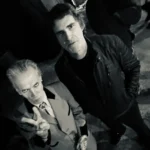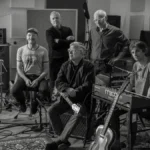
Drab Majesty performing live.
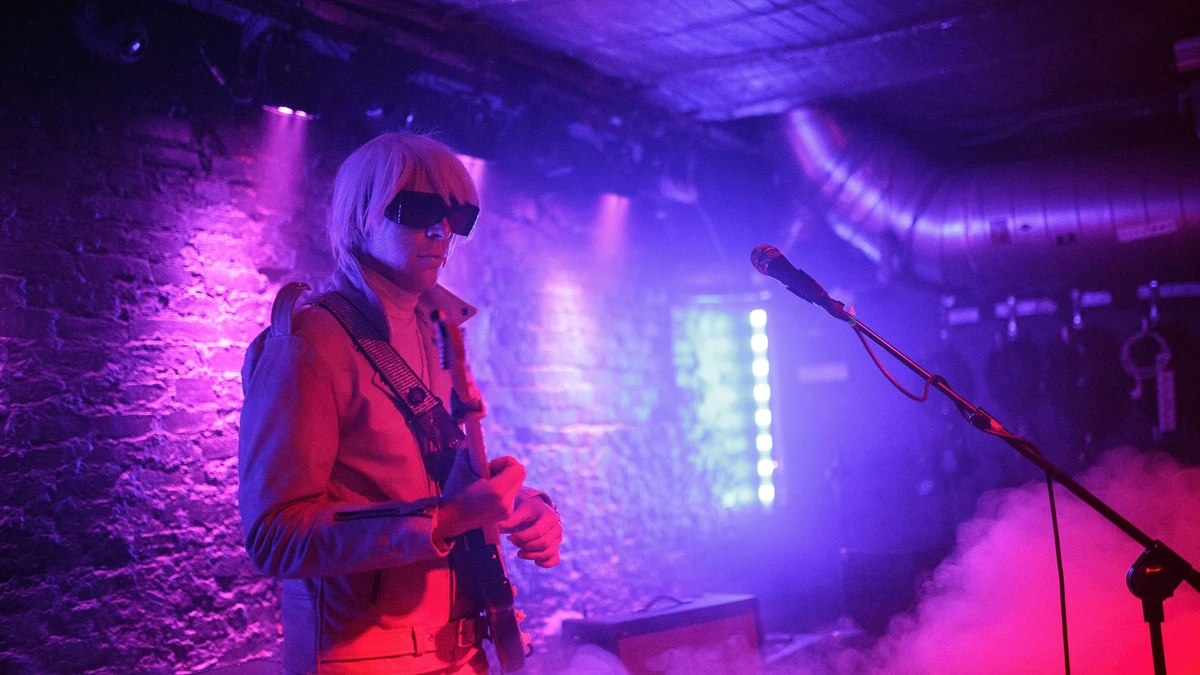
Drab Majesty performing live.
Drab Majesty started when a drummer recorded some songs alone and did not recognise the person playing them back.
He built a character to account for it, and has performed as that character ever since.
Not Recognising Your Own Recording
The founding story is unusually specific for a band mythology, and it describes something most musicians would recognise.
Playing back a recording you made alone is a genuinely strange experience. The performance is fixed, the room sound is unfamiliar, and the tiny decisions that felt deliberate at the time have become somebody else’s choices.
Most people ignore that feeling. Building an entire project around it is the unusual move, and it is why this act has a coherence that most costumed ones lack.
The character is not a marketing device bolted onto finished music. It came out of the recording process, which is why it fits the music rather than decorating it.
A Drummer Who Learned Guitar
He was a drummer, and was encouraged to learn guitar by a bandmate in the Los Angeles group he was playing in.
Drummers who take up melodic instruments tend to write differently from guitarists who do. They think in patterns and repetition rather than in chord changes, and the arrangement usually leads the melody rather than the reverse.
That is audible across this catalogue, where the parts stack up as interlocking figures rather than as verses moving through progressions.
A Guitar Lineage From Post-Punk
The guitar playing descends from a very particular corner of British music at the turn of the 1980s.
Two guitarists in that era developed an ornate, melodic, almost classical approach that had nothing to do with rock playing: clean tone, arpeggiated figures, and lines that function as counter-melodies to the vocal rather than as accompaniment.
That style disappeared almost entirely for two decades and has been rediscovered by exactly this scene, which is why a great deal of contemporary darkwave sounds more like 1981 art rock than like anything gothic.
Drum Machines and What They Enforce
The rhythmic foundation is programmed, which for a drummer is a considered decision rather than a limitation.
A drum machine plays with no variation in timing or velocity, which strips out everything a human drummer contributes and leaves an unbending grid.
What that grid does is expose everything else. With no rhythmic fluctuation to hide behind, a weak melody or an imprecise guitar part is completely audible, which is why the good records in this style are more meticulous than they sound.
Naming the Genre Yourself
He describes the style as tragic wave and as mid-fi, which are both invented terms.
Coining your own genre is usually a warning sign and occasionally useful, and the second term here is genuinely descriptive: not lo-fi, not polished, but deliberately located between the two.
Mid-fi is an accurate account of how these records sound. They are clearly not made in an expensive studio and they are clearly not accidents, and the space between those two things is where the aesthetic lives.
A Hundred Cassettes
The first release was an EP self-issued in 2012 on a hundred cassette copies, later picked up by a small label.
Cassette runs of that size are effectively a demo with packaging, and they are the standard first step in scenes with no radio and no press access.
What they establish is that a thing exists physically, which historically has been the trigger for a label to pay attention in a way that a digital upload is not.
Named After a UFO Cult
The EP took its title from a Californian UFO group whose public-access television broadcasts he has described as intoxicating.
Public-access television is a specific American cultural artefact: unregulated, unpolished, and occupied by exactly the kind of material that mainstream broadcasting excluded.
Borrowing from it fits an aesthetic built on the reprocessing of the 1980s, since that footage is the era’s strangest surviving document.
Signing to an Independent in 2015
The project signed to a Los Angeles independent in 2015 and has released everything through it since.
That label has become one of the central institutions of this scene, which matters more than its size. In a genre with no radio and limited press, a label functions primarily as a filter that an audience trusts.
A listener who buys everything a label releases is worth considerably more than one who follows an algorithm, and that relationship is what sustains a catalogue like this.
Three Albums Over Four Years
The three full-length albums came out in 2015, 2017 and 2019, with the debut recorded at home over two years.
Two years for a bedroom album is normal rather than slow, since the work fits around employment and there is no studio clock forcing decisions.
It also produces a specific quality. Records made in fragments over long periods tend to be more layered and less spontaneous than anything made in a booked session, which is audible here.
A Second Member
A keyboardist and vocalist joined in 2016, converting a solo recording project into a live band.
That transition is one of the harder ones in music, because a person who made everything alone has to hand some of it to somebody else.
For a project performed in character it is also a staging problem, since a second performer has to fit the world the character occupies rather than standing next to it in ordinary clothes.
Costume as Structure Rather Than Decoration
The visual presentation is elaborate and consistent, and it does something specific for the music.
A performer in character is not asking to be understood as themselves, which removes the confessional reading that dominates most contemporary songwriting. The lyrics can be about anything, because nobody assumes they are autobiography.
The cost is that a character has to be maintained. Every photograph, interview and performance has to stay inside it, and the moment it slips the whole apparatus reads as fancy dress.
Why the Eighties Keep Being Reprocessed
This entire scene is built on reworking a decade none of its younger listeners experienced, and the reasons are more practical than nostalgic.
The technology of that era is now cheap and abundant. Analogue synthesisers, drum machines and chorus pedals that were expensive professional equipment in 1983 are available second-hand or perfectly emulated in software, which means the exact sound is reachable by anybody.
There is also an aesthetic reason. That decade was the last one in which pop music was made with genuinely unfamiliar tools, and the results still sound slightly wrong in a way that later, more competent production does not.
What contemporary acts add is hindsight. They can take the parts of that era that aged well and discard the parts that did not, which nobody working in 1983 was able to do.
What a Persona Solves and What It Costs
Performing as a character has a long history in popular music and a consistent pattern of consequences.
The benefits are real. A persona gives a shy performer permission to be commanding, separates the work from the person’s ordinary life, and makes a live show a spectacle rather than four people playing.
The costs arrive later. A character can outgrow its creator, becoming the only thing an audience wants and closing off any other direction. It also makes ageing awkward in a way that being yourself does not, since a fixed persona does not get older.
The acts who manage it treat the character as a role rather than an identity, which is a distinction that is easy to state and evidently difficult to hold for fifteen years.
What Is Actually Being Tested
Two things. Whether a project founded on the sensation of not recognising yourself can continue once the process has become entirely familiar.
And whether a character invented in a bedroom in 2011 still fits the person performing it.
Three albums, one hundred cassettes, a UFO cult, and a drummer who did not recognise his own playing.
About The Author