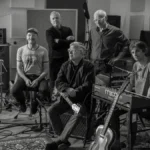

She Past Away performing at Blackfield Festival.
She Past Away performing at Blackfield Festival.
She Past Away finish their European autumn with a show on Christmas Day and another on Boxing Day.
Then they go to Spain in February.
Working Through Christmas
A German festival on 25 December and a Berlin club the following night is not a normal way to end a touring year.
Almost the entire live industry shuts down for that week. Crews go home, venues close, and the audience is assumed to be elsewhere.
That this scene supports two shows in that window says something specific about it. A subculture with a strong sense of itself produces an audience that would rather be in a dark room with each other than at home, and promoters who know that book accordingly.
It is also an entirely rational commercial decision, since nobody else is competing for those nights.
Fourteen Weeks of Europe
The autumn leg opens in Dublin in late September and runs to the end of December.
The routing covers Britain, Sweden, Norway, Poland, Germany, the Czech Republic, Belgium and the Netherlands, which is a genuinely dense European map rather than a handful of capitals.
Touring at that length requires an audience distributed across the continent rather than concentrated anywhere, which is characteristic of this genre and unusual almost everywhere else.
Adding Dates a Year Out
Three Spanish shows were added for February 2027, with further dates later that year in Germany and Austria.
Announcing eighteen months ahead is normally the preserve of arena acts, and for a club-level band it indicates confidence from the promoters rather than from the band.
It also lets an audience plan and lets a small band schedule its year, which matters when the members have other commitments between legs.
Singing in Turkish
The lyrics are in Turkish, and the band are among the most internationally successful acts ever to work in this genre from that country.
Turkish has a specific quality on record: a vowel-heavy, evenly stressed language that sits differently against a fixed drum machine pulse than English does.
That is not incidental. The vocal delivery in this music is closer to recitation than to singing, and the rhythmic character of the language becomes part of the arrangement rather than something laid over it.
A Country With Its Own Rock History
Turkey has a substantial and frequently overlooked history of psychedelic and progressive rock from the late 1960s onward.
That tradition combined Western rock instrumentation with Anatolian modes and rhythms, producing music that sounds like neither of its sources and has been extensively reissued in the last fifteen years.
A contemporary Turkish band working in an imported European genre is therefore doing something with more local precedent than it first appears.
A Duo With a Clear Division
The band is two people: one handling vocals, guitars and words, the other drums, synthesisers and production.
Splitting a band along that line is efficient in a way that a conventional four-piece is not, because there is no negotiation about who does what.
It also means that half the sound is being made by the person mixing it, which tends to produce records where the production and the arrangement are the same decision.
A Fourth Album in Seven Songs
The current album is a short record, which is a deliberate choice in a format that no longer has physical constraints.
Albums expanded to fill compact discs in the 1990s and have expanded again for streaming, where more tracks means more chances to be played.
Going the other way is a statement about editing. A seven-song album is one where somebody decided what to leave out, which is audible even when a listener does not know the running order.
Two Labels for Two Continents
The record came out through a Greek label in Europe and an American one in North America.
Split territorial deals are standard for independent acts and solve a real problem, since shipping physical stock across the Atlantic costs more than the records are worth.
Both labels here are long-established specialists in this genre, which matters more than reach. In a scene this defined, the label is a recommendation.
The Drum Machine as a Fixed Point
The rhythmic bed is programmed and unvarying, which is the defining constraint of the style.
Everything else in the arrangement is positioned against that grid: the bass slightly ahead or behind, the guitar in the gaps, the voice arriving late.
Those micro-decisions are the entire expressive range available, and it is why records that sound superficially identical are in fact quite different from one another.
Guitar Against Synthesiser
The sound combines a genuine electric guitar with synthesiser layers, which is not universal in this genre.
A great deal of contemporary darkwave is entirely electronic, which is cheaper, easier to reproduce live and considerably less interesting texturally.
Keeping a guitar in the arrangement introduces the one element that cannot be perfectly repeated, and it is what stops the records sounding like programming exercises.
Festivals as Infrastructure
The year closes at a German festival, and that country’s festival network is the backbone of this entire scene.
Several long-running German events draw international audiences in the tens of thousands, and they function as the meeting point for a subculture that is otherwise geographically scattered.
For a band from outside Europe, a slot at one of them reaches more of the relevant audience in ninety minutes than a month of club shows.
Why This Scene Tours So Heavily
The touring schedules in darkwave are disproportionate to the record sales, and the reason is structural.
Streaming pays almost nothing at this scale, and the genre has no radio, no playlist support and very little press outside its own specialist publications. What it has instead is an audience that reliably buys tickets and merchandise.
That inverts the usual relationship. For most bands touring promotes the record; here the record promotes the tour, which is where the income actually is.
It explains schedules like this one, where a fourth album released in February is still being toured a year later across three continents, and where dates a year and a half out are being announced before the current leg has begun.
What a Subculture Provides That a Genre Does Not
The distinction is worth drawing, because it explains why acts in this field have such durable careers on such modest numbers.
A genre is a description of what music sounds like. A subculture is a set of people with shared dress, venues, festivals, record shops and social networks, for whom the music is the centre of something larger.
Audiences of the second kind behave completely differently. They travel to shows, buy physical records, attend annually, and stay for decades rather than seasons. They are also considerably harder to reach with conventional marketing, which is why the specialist labels and festivals matter so much.
Two shows on the two days of the year when nothing else happens is the clearest possible demonstration of the difference.
What Is Actually Being Tested
Two things. Whether a fourteen-week European autumn ending on Boxing Day is sustainable for a two-person band, or a schedule that produces one very tired February.
And whether dates announced eighteen months in advance still sell when they arrive.
Four albums, two labels, one European autumn, and two shows in the week nobody else plays.
About The Author