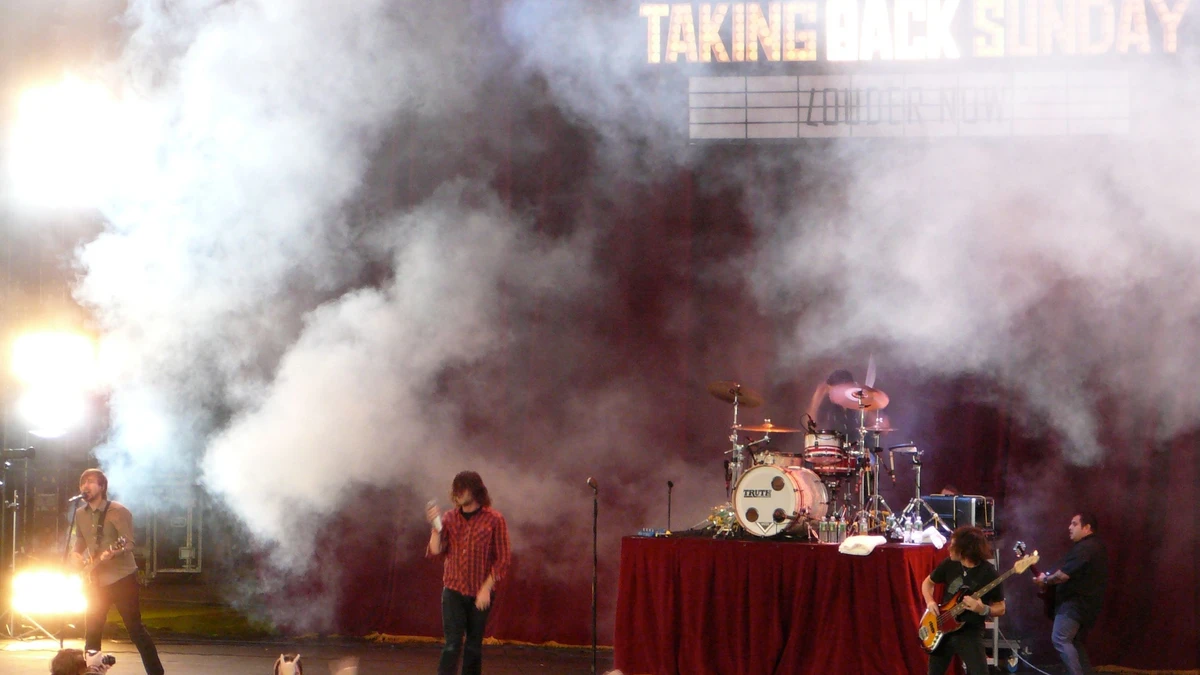
Taking Back Sunday performing live during the Louder Now era.
Taking Back Sunday performing live during the Louder Now era.
Taking Back Sunday will play a twenty-year-old album from start to finish on one night in October.
The guitarist who played on it has been invited back for the whole year.
One Night, One Album
The full performance happens once, at a Colorado amphitheatre, and nowhere else on the tour.
Restricting it to a single date is a considered decision. Playing an album in full every night turns a tour into a fixed recitation, and it also removes any reason to attend more than one show.
Doing it once makes that night an event and leaves the rest of the run free, which is the arrangement more bands should use and few do.
It also concentrates demand. A single performance of a record with this much history attached is a considerably easier ticket to sell than the fourteenth.
A Venue Carved Into Rock
The show is at an open-air amphitheatre built between two enormous sandstone formations at altitude outside Denver.
It is one of the few genuinely famous venues in American music, and its reputation rests on acoustics produced by geology rather than engineering.
Playing it is a career marker in a way that most rooms are not, which is part of why a band would choose it for a one-off rather than a bigger city.
A Guitarist Coming Back
The guitarist who played on the album has been invited to perform alongside the band’s current guitarist for every show this year.
That is more significant than a guest appearance. It means a lineup that includes both the player who left early in the band’s history and the one who replaced him, which is not a configuration that existed at the time.
Reunions of this kind are usually built around a single anniversary night. Extending it across a full year suggests something more than a commemorative gesture.
Two Guitarists Changes the Arrangements
Adding a second guitarist to a band that has been operating with one has immediate musical consequences.
Records of this era were made with layered guitars, and a live band with one player has to choose which layer to play, usually the rhythm part, losing the counter-melodies entirely.
With two, the arrangements can be performed as recorded, which for an album being played in full is close to a requirement rather than an improvement.
Two Voices in the Chorus
The band’s signature is a second vocal answering the lead rather than harmonising with it.
That interlocking, overlapping vocal became one of the defining sounds of the genre, and it works because the two lines say different things at the same time.
It also requires two singers who can hold a part against another, which is why the arrangement collapses when one of them is absent.
Melody Underneath the Volume
The songs are loud, fast and built on choruses that a large room can sing, which is melodic rock construction rather than punk.
The markers are consistent: guitar hooks that function as second melodies, choruses that arrive early and repeat, and bridges that drop out entirely to make the final chorus land harder.
That craft is why records from this scene have aged into something people pay to hear performed complete twenty years later, while a great deal of louder and more sincere music from the same years has not.
Twenty Years of a Specific Album
The record being celebrated came out in 2006, at the point where this genre reached its widest audience.
Albums from that moment have a particular status now, because they were bought by a very large number of people who were teenagers at the time and are now in their late thirties with disposable income.
That demographic is the entire economic basis of the current anniversary-tour economy, and it is why so many 2005 and 2006 records are being toured this decade.
A Two-Month American Tour
The main run goes from mid-September to mid-November, opening in Nashville and finishing in Florida.
Two months is a full American touring cycle, covering the Midwest, the East Coast and the South rather than the coastal cities alone.
Routing at that density only works for bands with a genuinely national audience, which for this genre was built through relentless touring twenty years ago and has largely stayed put.
Festivals on Either Side
The year also includes several large American festivals and a travelling punk festival that has returned after a long absence.
Festival slots and headline dates serve different purposes. A headline show sells to the existing audience; a festival puts the band in front of people who came for somebody else.
For a band twenty years into a career, the second is the only realistic route to new listeners, since the press and radio channels that once did that job no longer exist at scale.
An Anniversary Reissue
An expanded edition of the album is being prepared with a reissue specialist.
Catalogue reissues have become one of the more reliable revenue lines in music, because the recordings exist, the audience is identified, and physical formats sell at margins that streaming cannot approach.
Pairing a reissue with a single full-album performance is efficient scheduling: the show promotes the record and the record extends the show.
Where the Genre Went
The scene this band came from was enormous for roughly five years and then largely disappeared from mainstream attention.
What happened was not a collapse in quality but a shift in infrastructure. The magazines, television channels and touring festivals that carried this music all contracted at once in the early 2010s.
The bands that survived did so by keeping their audiences directly, which is why the ones still touring can fill theatres despite having had no mainstream coverage for a decade.
Why Full-Album Shows Work Better Once
The format has become standard and it has a well-understood weakness worth setting out.
An album played in full is a fixed object. The sequencing was designed for a listening experience at home, not for a room, which means the pacing is frequently wrong live: two slow songs in a row in the middle, a closing track that was written to fade rather than to end a night.
A band playing it every night for two months has to live inside that structure, and the middle of the set becomes something to survive rather than perform.
Doing it once solves all of that. The audience gets the complete record as an occasion, the band gets to build a proper set on every other night, and nobody has to pretend the album’s sequencing was designed for a stage.
What Bringing Back a Former Member Actually Involves
Reintegrating a musician who left nearly twenty years ago is more complicated than the announcement suggests.
The band has played these songs several thousand times since he left, and the live arrangements have drifted from the recordings. He has to learn the current versions rather than the ones he played on, which is a strange position for the person who wrote several of the parts.
There is also the social question. A returning member has a claim on the past and no claim on the present, and the arrangement works only if everybody involved is clear about which one is being celebrated.
Committing to a full year rather than one night is the strongest available signal that it has been thought about properly.
What Is Actually Being Tested
Two things. Whether a lineup that never existed at the time can serve a record that specific, or whether the audience simply wants what it remembers.
And whether a single full-album night at a famous venue is a better use of an anniversary than a tour built around it.
Twenty years, two guitarists, one night in October, and a record played the way it was made.
About The Author