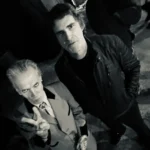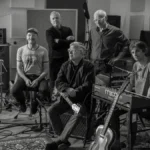
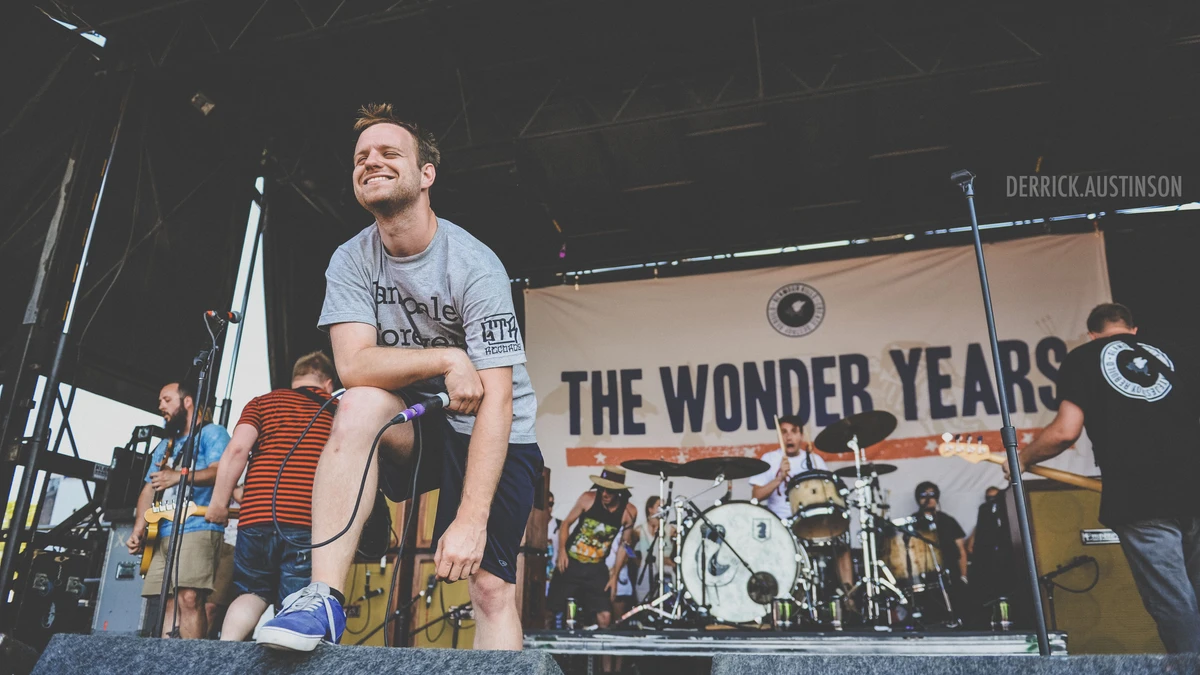
The Wonder Years performing at Warped Tour.
The Wonder Years performing at Warped Tour.
The Wonder Years have made seven albums with the same core group since 2005.
Their singer has also written four releases in the voice of a man who does not exist.
A Character Study Set to Music
The side project is described by its own creator as a character study conducted through music, with every lyric written in the voice of an invented person.
That is unusual in a genre organised almost entirely around autobiography. The whole appeal of this kind of writing is that it is understood to be true, and inventing a narrator removes exactly that.
He has said the aim was to make fiction feel as raw and personal as writing about his own life, which is a genuinely difficult brief and the reason most people do not attempt it.
What makes it work is consistency. The character has a history, a geography and a chronology across four releases, which turns the project into a novel rather than a gimmick.
Why Fiction Is Harder Than Confession
Autobiographical songwriting has a built-in advantage that is easy to overlook.
A listener extends credit to a true story automatically. Details that would seem arbitrary in fiction are accepted as real because they are, and specificity is free.
Fiction has to earn all of that. Every detail must be chosen, and any that feels invented breaks the illusion, which is why most attempts collapse into vagueness within a verse.
Ten Years With One Character
The project began in 2014 and has continued across a decade, with the most recent album in 2024.
Sustaining an invented narrator for ten years means the character ages alongside the writer, which produces something closer to a serialised novel than to a series of records.
It also means the audience has followed a fictional life for a decade, which is a considerably stranger relationship than the one they have with the main band.
Twenty Years With the Same People
The band formed in 2005 out of an earlier local group, and most of the current lineup has been there throughout.
Twenty years with a stable membership is rare and it is the single strongest predictor of a long career, because the alternative is spending every few years rebuilding.
The first rehearsal reportedly took place in the drummer’s basement, where they wrote a song that made the debut album, which is about as ordinary an origin as exists.
Six People on Stage
The band is a six-piece, with two dedicated guitarists plus a keyboard player who also plays guitar.
That is a large band for this genre and it changes what the arrangements can do. Three guitar parts at once allows counter-melody rather than everybody playing the same chords louder.
Keyboards fill the space underneath, which is why these records sound full in a way that four-piece emo generally does not.
Choruses Built to Be Shouted Back
The songs are constructed around choruses that a room can sing without knowing the words, which is a specific craft.
The requirements are consistent: a phrase short enough to catch on one hearing, a melody in a range most people can reach, and a rhythm that lands on the beat rather than around it.
That is melodic rock writing rather than punk writing, and it is what separates the bands from this scene who fill theatres from the ones who stayed in basements.
Melody Carrying the Weight
The genre is frequently characterised by its lyrical content, which understates how much of the effect is musical.
A line about loss delivered over a major-key chorus at full volume produces a completely different feeling from the same line delivered quietly, and the contrast between the two is the entire mechanism.
Bands who get this wrong match sad words to sad music, which is redundant. The good ones set the darkest lines against the biggest melodies.
Pennsylvania Rather Than a Scene City
They come from a town outside Philadelphia, not from one of the cities associated with this music.
Suburban origins are close to universal in this genre, and that is not a coincidence. The music is substantially about the experience of growing up somewhere with nothing to do, which requires having done it.
It also means the early audience was built through touring rather than through a local scene, which is slower and produces a more distributed following.
Two Hundred Days a Year
The singer has said that between 2010 and 2014 the band toured roughly two hundred days a year, and then stopped hard when his wife became pregnant.
Two hundred days is close to the maximum a band can physically do, and it is how acts without radio support build an audience city by city.
It is also unsustainable, and the point at which a band stops is almost always a personal one rather than a commercial decision.
Acoustic Re-Recordings
The band have released stripped-down re-recordings of their own catalogue, including versions with a string quartet.
Acoustic reworkings are a well-established move and they serve a specific purpose: they demonstrate that the songs work without volume, which is the standard accusation levelled at this genre.
They also give a band something to release between albums that costs a fraction of a new record and reaches the existing audience directly.
Longer Sets as a Format
A recent touring format involved two sets in one night, playing more songs than the band had previously attempted.
That is a serious commitment for a singer whose delivery is at the top of his range for most of a set, and it requires physical preparation rather than just rehearsal.
It is also a good answer to the heritage-tour problem. Rather than picking between eras, a band with a deep catalogue can simply play more of it.
What Running Two Projects Actually Costs
Maintaining a band and a separate parallel catalogue looks like productivity and is mostly a scheduling problem.
The two projects compete for the same finite resources: writing time, studio time, touring windows and, critically, the same audience’s attention and money. A year spent on one is a year the other did not exist.
There is also a creative cost that is less obvious. Ideas that would have gone to the band go to the character instead, and a songwriter with two outlets has to decide which voice each song belongs to before knowing whether it is any good.
What makes it worth doing is that the two demand genuinely different things. Writing in someone else’s voice removes the limits of one’s own life, and coming back to autobiography after that tends to sharpen it.
Why This Genre Produces Side Projects
Emo and its adjacent scenes generate an unusual number of solo and character projects, and the reasons are structural.
The music is built on a single narrating voice, which means the frontman is already doing something closer to writing than to fronting, and writers accumulate material that does not fit one format.
The audience is also unusually tolerant of departures. A listener who came for confessional lyrics will follow a songwriter into folk, country or fiction far more readily than a metal audience will follow a guitarist into anything quieter.
That combination is why a singer in a loud six-piece can release a decade of country-inflected songs about an imaginary man and keep the same audience for both.
What Is Actually Being Tested
Two things. Whether a fictional narrator can be sustained past the point where the audience knows the whole story.
And whether a band twenty years in can keep two parallel bodies of work moving without one of them quietly stopping.
Seven albums, four releases in a borrowed voice, twenty years, and one basement in Pennsylvania.
About The Author