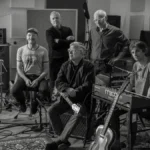

Yvette Young of Covet performing in Seattle.
Yvette Young of Covet performing in Seattle.
Covet are built around a guitarist who does not use the chord shapes every other guitarist learns first.
She came to the instrument from piano and violin, and taught herself by ear.
Learning the Wrong Way Round
Most guitarists learn a set of fixed hand positions early and then spend years working outward from them.
Somebody who arrives from piano has no such positions. A pianist thinks in intervals and voicings rather than in shapes, because the keyboard lays the notes out in a straight line and the hand can reach any combination.
Transferring that thinking to a guitar, where the same note appears in several places and the tuning determines what is reachable, produces voicings that a conventionally trained player would never find.
She has said directly that she does not use traditional shapes at all, and that this alarms people who watch her play.
A Large Number of Tunings
The other half of the method is working in a great many alternate tunings rather than one.
Changing a tuning changes which notes fall under the fingers, which means chord voicings that are physically impossible in standard become straightforward.
The cost is that everything learned in one tuning is useless in another, which is why most guitarists use one or two. Somebody writing by ear rather than by shape does not pay that cost, because there was nothing memorised to lose.
Singing the Part First
The writing method involves singing a part out loud and then finding it on the instrument.
That is closer to how a composer works than how a guitarist does, and it inverts the usual process. Most guitar music is discovered by moving hands around until something sounds good, which means the instrument decides what gets written.
Starting from a sung melody removes the instrument’s opinion entirely, and it is why these pieces have melodic shapes that guitars do not naturally produce.
Two Hands on the Fretboard
The playing relies heavily on tapping, where both hands work on the neck rather than one picking and one fretting.
That allows genuine polyphony: independent melodic lines running at the same time, in the way a pianist plays two hands.
It is also visually striking, which is not a trivial point for an instrumental band. An audience with no singer to watch needs something to look at, and the technique supplies it.
An Instrumental Band
There is no vocalist, which is the single decision that shapes everything else.
Without a voice, the melody has to be carried by the guitar, which means the guitar parts cannot be accompaniment. Every piece needs a tune that a listener can follow and remember.
It also removes the primary route to a mainstream audience, since almost all popular music is organised around a singer, and it means the songs have to work purely on construction.
Where Math Rock Comes From
The genre name refers to unusual time signatures and shifting metre, though the label describes only part of what these bands do.
The lineage runs from progressive rock through 1990s American post-hardcore and into a scene that is now largely instrumental and international, with a substantial contingent in Japan and East Asia.
What unites it is an interest in structure over volume, and a willingness to make music that requires attention rather than rewarding background listening.
Melody Instead of Difficulty
The failure mode of this genre is technical display that nobody enjoys hearing twice.
Music built on rhythmic complexity can very easily become an exercise, impressive to other musicians and tedious to everybody else, and a large amount of it is.
What separates the records that last is melodic writing, and it is why this band gets described as emotional and cinematic rather than as clever, which is the more useful compliment.
A Family of Musicians
She grew up with two musician parents and began piano at four and violin at seven.
Classical training at that age produces specific advantages: reading, theory, ear training and the discipline of practising something until it is correct.
It also produces a specific problem, which is that classical study rewards accuracy over invention, and a great many trained musicians never make the transition to writing their own material.
Teaching Herself During an Illness
She took up guitar while recovering from a serious illness, teaching herself by ear rather than through lessons.
Learning an instrument alone, without an instructor correcting technique, is how idiosyncratic styles form. Nobody is present to say that a particular approach is wrong.
The music that results tends to be unlike anything else, which is the compensation for having done it the difficult way.
An Audience Built on Video
Her career began with videos of herself playing, posted online, well before there was a band.
Instrumental guitar music is close to ideally suited to that format, because the appeal is watching something difficult being done, and no context is required.
It is also why an instrumental band with no radio presence and no vocalist can tour internationally, which would have been close to impossible for the same music twenty years ago.
Teaching as Part of the Job
She runs guitar courses and clinics alongside the touring, having previously worked as an art teacher.
Teaching has become a significant income stream for instrumentalists with a distinctive technique, and it is considerably more reliable than record sales at this level.
It also feeds back into the playing, since explaining an approach to somebody else forces a clarity about it that intuition alone does not require.
Why Instrumental Bands Tour So Far
An instrumental act has one large structural advantage that compensates for having no singer.
There is no language barrier. A band whose songs are entirely instrumental is exactly as accessible in Taipei, Tokyo, Jakarta or Manchester as it is at home, which is why this scene has an unusually even global distribution and why its bands tour Asia as a matter of course rather than as an ambition.
The audiences are also unusually engaged. Instrumental music demands attention, so the people who show up have chosen to pay it, and they tend to be musicians themselves, which produces a room that watches rather than talks.
What it costs is scale. Without a voice there is no route to radio, no playlist placement of the usual kind and no chance of a crossover single, so the ceiling is a mid-sized venue in a large number of countries rather than an arena in a few.
What Not Learning the Rules Actually Buys
The idea of an artist who never learned the conventions is romantic and usually overstated, and it is worth being precise about what is happening here.
She is not untrained. Fifteen years of piano and violin is a considerably deeper musical education than most guitarists ever receive, and the theory, ear and discipline all transferred intact.
What she skipped was specifically the guitar’s conventions: its standard tuning, its stock shapes, its inherited vocabulary of licks and positions. Those conventions exist because they work, and they also constrain what a player thinks of, because a hand that knows fifty shapes reaches for one of them.
Arriving with a complete musical education and none of the instrument’s habits is a rare combination, and it is the whole explanation for why this music does not sound like other guitar music.
What Is Actually Being Tested
Two things. Whether an instrumental band can keep growing an audience without the one element almost all popular music depends on.
And whether a method built on avoiding the instrument’s conventions keeps producing new material once it has become a method of its own.
Three albums, no singer, dozens of tunings, and a guitarist who sings the part before she plays it.
About The Author