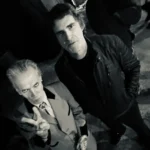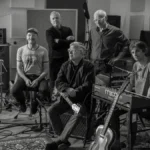
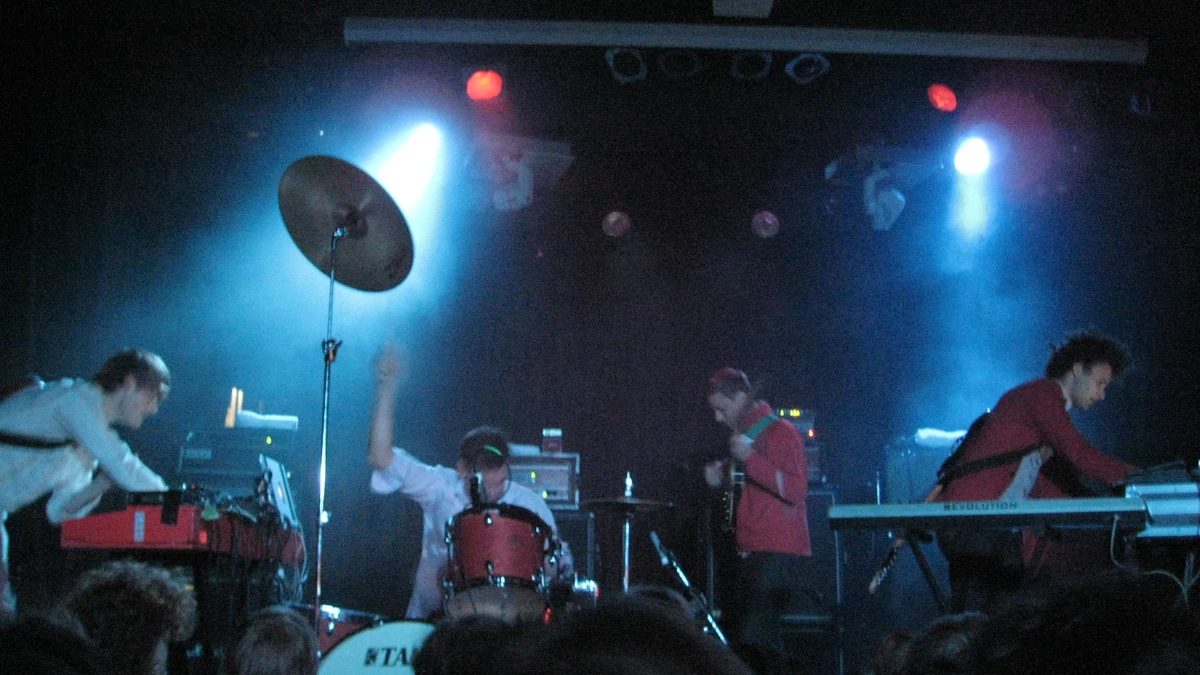
Battles performing live.
Battles performing live.
Battles started as four people in New York and are now two.
They have lost a member roughly every other record and kept making the same kind of music.
A Band Assembled Rather Than Formed
The group was put together in 2002 by a guitarist and keyboardist who had already played in two earlier instrumental bands.
That is a different origin from the usual one. Most bands form because a few people happen to know each other; this one was assembled deliberately, from musicians chosen for what they could do.
The drummer had spent a decade in a New York alternative metal band known for extreme rhythmic precision, which is exactly the discipline this music requires.
Bands built that way tend to be technically formidable and socially fragile, and the membership history here fits the pattern.
Losing Two Members and Continuing
A composer and vocalist left after the first album, and a bassist left before the fourth.
Most bands do not survive losing their most visible member, and this one lost two across a decade without changing direction.
That suggests the identity was never located in any one person, which is unusual and is probably a consequence of the music being instrumental and constructed rather than performed by a frontman.
An Album That Defined a Decade of Guitar Music
The first album arrived in 2007 and was immediately influential well beyond the scene it came from.
It was preceded by a single that became a genuine crossover, reaching a dance audience and being named single of the week by the British weekly press.
An instrumental piece in an unconventional metre reaching that audience is close to unheard of, and it opened the door for a substantial number of bands who followed.
A Flesh-and-Blood Band With Computers
What made the record distinctive was the combination of live playing and machine processing.
Loops are built on stage from parts played in the room rather than triggered from a file, which means the music is simultaneously programmed and performed.
One critic at the time wrote that nobody had done more to extend the idea of a live band enhanced by computers in almost two decades, which was a large claim and has broadly held up.
Loops Built Live
The technique deserves explaining, because it is the core of what this band does.
A player records a phrase into a looping device on stage, then plays over it, then records another layer on top, building an arrangement in front of the audience.
The demand is absolute rhythmic accuracy. A loop recorded fractionally out of time repeats that error indefinitely, which is why this method requires a drummer capable of playing to a machine without drifting.
A Drummer Playing Like a Machine
The drumming across these records is deliberately mechanical, holding an unvarying tempo underneath everything else.
That is the opposite of what rock drumming normally values, which is feel, push and human variation.
Here the drums function as the clock the loops are locked to, which requires a specific and quite rare kind of discipline, and it is why the band’s live show works at all.
Time Signatures That Do Not Resolve
The compositions move through metres that do not settle into a comfortable count.
What that produces is a listener who cannot quite anticipate where the next accent falls, which is disorienting at first and hypnotic once the ear adjusts.
It is also the defining formal characteristic of the genre, and this band’s application of it is unusually musical, since the odd metres serve the piece rather than announcing themselves.
An Electronic Label for a Rock Band
The records come out through a label built on electronic and experimental music rather than on guitar bands.
That is a positioning decision as much as a business one. It places the music alongside abstract electronic records rather than alongside rock, which is where the interesting comparisons are.
It also means no pressure to produce a single, which for a band whose pieces run several minutes and have no vocals is close to essential.
Vocals as an Occasional Guest
After the original vocalist left, the band used guest singers on individual tracks rather than recruiting a replacement.
That approach keeps the band instrumental by default while allowing a voice where a piece needs one, and it produces albums with considerably more variety than a fixed lineup would.
It is also administratively awkward, since guests cannot tour, which means the live versions differ from the recordings by necessity.
A Very Tall Cymbal
The drum kit carries a crash cymbal mounted far above the rest of the setup, high enough to require standing and reaching.
It is visible in almost every photograph of the band and has become the most recognisable thing about their stage setup.
Whatever the reason, the practical effect is that every hit on it is a deliberate, visible physical event rather than something absorbed into a pattern, which suits music this precise.
Why a Duo Is a Stable Configuration
Reducing to two people looks like attrition and is arguably the most durable shape available to this band.
Two members means no factions, no majority votes and no ambiguity about who decides. The disagreements that end four-piece bands are mostly about which of several people gets their way, and that argument does not exist here.
The music also permits it in a way that most rock does not. A group whose arrangements are built from loops and layers does not need one person per part, because the layers are assembled rather than played simultaneously by separate hands.
What it costs is the live show, which becomes considerably harder when two people have to cover material written for four, and it is why bands in this position either simplify the arrangements or accept a more machine-dependent performance.
What Seven Years Between Albums Means Now
The most recent record is several years old, and the band has not announced a successor.
For a group of this kind that is less alarming than it would once have been. There is no label schedule to satisfy, both members have other projects, and an experimental catalogue does not decay in the way a pop one does.
The risk is the ordinary one. A gap that started as a pause becomes the status quo, and a band that has not formally stopped can spend a decade not quite existing.
What tends to break that pattern is a live offer rather than a creative impulse, which is why festival bookings so often precede the announcement of a record.
Why New York Produced This Band
The city’s role here is more specific than geography usually is, and it explains why the group could be assembled at all.
New York in the early 2000s held an unusual concentration of musicians who had already been through one significant band and were looking for the next thing. That is a very different labour pool from a city where everybody is in their first group, and it makes a band built by recruitment rather than friendship possible.
The city also had, at that point, a downtown tradition that took experimental composition seriously and did not treat it as separate from rock. Musicians moved between those worlds routinely, which is why a band could combine metal-derived drumming, instrumental guitar writing and computer processing without anybody finding the combination strange.
What has changed since is the rent. The loft spaces and cheap rehearsal rooms that made that scene possible have largely gone, and the equivalent bands now form in cities that are still affordable. That is a loss with no obvious replacement, and it is why a group assembled this way is harder to imagine happening there today.
What Is Actually Being Tested
Two things. Whether a band that has shed half its membership can keep producing arrangements built for more people than are present.
And whether an approach that was genuinely new in 2007 still sounds new now that a generation of bands has absorbed it.
Four albums, two members, one very high cymbal, and a method everybody copied.
About The Author