
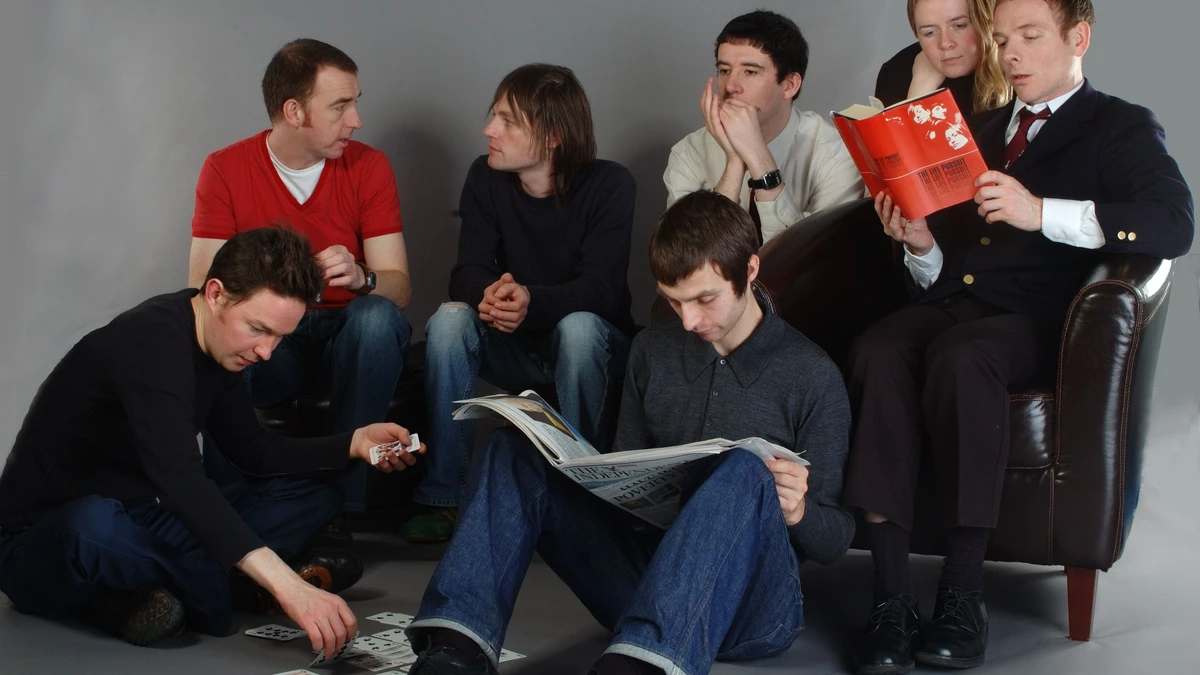
Belle and Sebastian, press portrait.
Belle and Sebastian, press portrait.
Belle and Sebastian are playing two nights in every city, with a different album each evening.
Both records came out in the same year, thirty years ago.
Two Albums in One Year
The unusual fact underneath this tour is that a band released two albums within months of each other at the very start of its career, and both became foundational.
That was normal practice in the 1960s and had almost entirely stopped by the 1990s, when a record required a year of campaign around it.
It happened here because the band was operating outside the usual machinery, recording quickly and cheaply with no expectation that anybody would notice.
Thirty years later it produces a genuinely unusual anniversary problem: two records, one year, and no obvious way to celebrate one without the other.
The Two-Night Solution
Rather than choosing, the band play both, on consecutive nights in each city.
That is a considerably better answer than a combined set, which would have to cut both records and would satisfy nobody.
It is also commercially clever. An audience that wants both albums buys two tickets, and the band plays two shows on one set of travel and production costs.
A Second Set Every Night
Each evening pairs the album with a further set drawn from the rest of the catalogue.
That solves the main weakness of the full-album format, which is that a record designed for home listening rarely has the pacing of a good live set.
It also means the two nights differ in more than one way, which gives somebody attending both a genuinely different second evening rather than a variation.
Twenty-Six Nights Across Thirteen Cities
Doubling up means the tour covers half as many places for the same number of shows.
The routing takes in Switzerland, France, the Netherlands, Germany, Sweden, Norway, Denmark, Ireland, Britain, Mexico, the United States and Canada, with the band’s home city later in the year.
Only booking cities where two nights will sell is a substantial constraint, and it is the clearest evidence of where an audience actually is rather than where a promoter hopes it might be.
Two Nights at a Concert Hall
The London dates are a pair at a Victorian concert hall built for orchestras rather than bands.
Rooms of that kind suit this catalogue unusually well, since the arrangements involve strings, horns and keyboards and depend on being heard clearly rather than loudly.
They are also a considerable step up in prestige from the venues a band from this scene would once have expected to reach.
Chamber Pop Rather Than Rock
The arrangements have always drawn on instruments outside the standard band format.
Strings, brass, woodwind, piano and organ appear throughout, arranged as parts rather than as decoration, which places the music closer to 1960s orchestral pop than to indie rock.
That is why the records sound warm rather than loud, and why they have aged considerably better than most guitar music from the same decade.
Melody Before Everything
Underneath the arrangements, the writing is straightforwardly melodic in a way that indie rock frequently is not.
The vocal lines are the songs. They are singable, they resolve, and they would work on an acoustic guitar with nothing else attached, which is the standard test of a pop melody.
Bands who write that way tend to have long careers, because a good melody does not date in the way that a production style does.
Songs With Characters in Them
The lyrics are populated by named people doing specific things, which is closer to short fiction than to conventional songwriting.
That approach was distinctive when the first records appeared, in a decade when most British guitar bands were writing either about themselves or about nothing in particular.
It also explains why the singer has since published a novel, and why the catalogue has an unusually literary reputation for a pop band.
Recording Outside the Industry
The first album emerged from circumstances entirely outside the normal music business, which shaped everything about how it sounds.
Records made without a label’s expectations attached tend to be stranger, quieter and more idiosyncratic, because nobody is asking for a single.
The commercial consequence arrived later and the artistic one was immediate, which is the usual order for records that end up mattering.
A Band of Seven
The group has operated as a large ensemble for most of its existence, with several members contributing writing.
Bands that size are expensive to tour and difficult to keep together, and they can produce arrangements a four-piece simply cannot.
They also tend to be more durable than smaller groups, because no single departure is fatal and the songwriting is distributed rather than dependent on one person.
Two Albums in 2022 and 2023
The band released consecutive albums in successive years recently, which is a deliberate echo of how they began.
Back-to-back releases have become rare for established acts, since the promotional cycle around a single record now occupies most of two years.
Doing it anyway suggests a band operating on its own schedule, which is the position a long career and a stable audience eventually buys.
Why an Anniversary Needs a Format
Anniversary tours have become close to universal, and the ones that work do so because they have a real idea rather than a date.
A tour that simply announces a number and plays the usual set is asking an audience to pay for a coincidence of the calendar. The audience notices.
What justifies the ticket is a format that could not exist otherwise. Two albums on two nights is exactly that: a proposition that only makes sense for this specific band in this specific year, and one that is impossible to replicate next time.
It also creates a natural ending. When the tour finishes, the idea is complete, which spares everybody the slow decline of an anniversary run that keeps being extended.
What Two-Night Stands Reveal
The format is a considerably harsher commercial test than a conventional tour, and it is worth being clear about why.
A single date in a city can be filled by casual attendees, people brought along by friends, and anybody who happened to see a poster. A second consecutive night in the same room can only be filled by people who care enough to come twice, or by a market deep enough to supply two separate audiences.
Very few bands at this level can do it. Most who try end up quietly downgrading the second night to a smaller room or cancelling it altogether.
Announcing thirteen cities of doubles is therefore a considerable statement of confidence, and the tour’s real result will be measured in how many of those second nights sold.
Glasgow at the End Rather Than the Start
The band’s home city gets its dates months after the rest of the run, in late June rather than in the February and March opening leg.
Home shows placed at the end are a deliberate sequencing choice. By that point the two sets have been played more than twenty times, the transitions are solved, and the band is performing rather than working out how the evening goes.
There is also the audience to consider. A home crowd contains everybody who has followed the band since the beginning, including the people who were in the rooms where these records were first played. That is the least forgiving and most invested audience of the tour, and it is worth arriving prepared.
Glasgow matters more than usual for this particular group, because both albums are so specifically a product of that city at that moment. Playing them there closes a loop that the rest of the tour can only describe.
What Is Actually Being Tested
Two things. Whether an audience will attend twice in one week for two records made thirty years ago.
And whether a band whose recent work has been prolific can spend a year looking backwards without the catalogue becoming the whole story.
Two albums, two nights, thirteen cities, and one year in 1996 that produced both.
About The Author